Course contents
From one leg to many
A single option can only say so much. Combining legs lets you shape both your view and your risk, and every combination trades one thing away to gain another.
- Explain why a trader adds a second leg instead of buying one option
- See that a spread can lower cost and cap loss at the same time it caps gain
- Understand that every strategy is a trade, giving something up to get something back
You have just finished Options Basics, so you can already buy a call, buy a put, and sell either one. Those four moves are the whole alphabet of options. This course is about the words you can spell with them.
Start with a problem you already understand. Say you think NIFTY, which is trading around 24,000, will drift up over the next couple of weeks. In Options Basics you learned the obvious move: buy a call. The nearest call might cost 150 points, and since a NIFTY lot is 65 units, that is 9,750 rupees for one lot. You also learned the catch. Time decay eats that premium every day, and NIFTY has to climb past 24,150 just for you to break even. A slow, gentle rise, exactly the one you predicted, can still leave you with a loss.
So ask a sharper question. What if you paid less, broke even sooner, and still profited from the gentle rise you actually expect? You would have to give up something for that. The thing you give up is the part of the move you were probably never going to catch anyway.
Adding a second leg
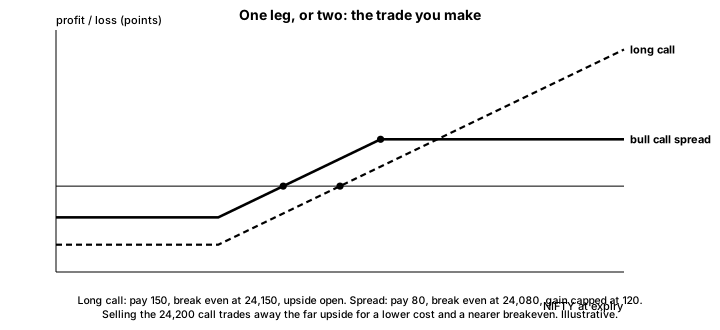
Here is the move. You buy the 24,000 call for 150, as before. Then you also sell a 24,200 call, and someone pays you 70 points for it. Your net cost is no longer 150. It is 150 minus 70, which is 80 points, or 5,200 rupees for the lot. You have built your first spread, a position made of two or more option legs working together.
Look at what changed. Your cost dropped from 9,750 to 5,200. Your breakeven dropped from 24,150 to 24,080, so a smaller rise now puts you in profit. In exchange, you gave up one thing: if NIFTY rockets past 24,200, you do not keep climbing with it. Above 24,200 the call you sold starts costing you exactly as much as the call you own keeps gaining, so your profit stops. It stops at a good number, 120 points or 7,800 rupees, but it stops.
That is the entire idea of this course in one example. A single option makes a blunt bet. A combination lets you say something precise: "I think NIFTY grinds up to somewhere around 24,200, not to the moon." You shaped your view. And at the same moment, by taking in that 70 points, you shaped your risk, cutting what you paid and therefore what you can lose. One move did both.
There is no free structure
It is tempting to read that spread and think you outsmarted the market: cheaper, lower breakeven, still bullish. You did not get those for nothing. You paid with the upside above 24,200. If you had been sure NIFTY would jump 800 points, capping your gain at 120 would be a poor trade, and the plain call would have been better. Every strategy is like this. It is good for one view and poor for another, and the skill is matching the structure to what you actually believe.
Some combinations also carry a risk a single bought option never can. When you sell a leg that is not fully covered by another leg you own, you take on the seller's open-ended risk you met in Options Basics. This course will point at that danger every single time it appears, and it will keep steering a beginner toward structures where the most you can lose is a number you can write down in advance.
The map ahead
Niota's strategy builder comes with about 38 ready-made strategies, sorted into four tabs by market view: Bullish, Bearish, Neutral, and Others. By the end of this course you will understand every one of them, know when each fits, and be able to build any of them yourself. That is the destination.
The path there starts with tools, not strategies. The next five chapters build the six things you need to read any structure on sight: the two questions every strategy answers, how to read a payoff diagram in the builder, how to work out its numbers by hand, how its Greeks decide its day-to-day behaviour, and how margin, costs, and liquidity separate a good-looking diagram from a trade you can actually place. Learn those, and the 38 strategies stop being a list to memorise and become variations on a handful of ideas you already understand.
What to carry forward
A single option is one blunt bet. Adding legs lets you shape your view and your risk together, and the NIFTY spread showed the trade in miniature: you gave up the far upside to pay less, break even sooner, and cap your loss at a known 5,200 rupees. Hold on to the one rule under all of it: every strategy trades something away to gain something back, so the question is never "is this a clever structure" but "is this the right structure for what I believe." The next chapter sharpens what you believe into its two real parts, direction and volatility.