Course contents
What the payoff diagram leaves out
The payoff diagram is drawn in a world with no costs. Real profit trails it, because of brokerage, the bid-ask spread, and taxes, and one Indian rule in particular: the securities transaction tax charged on the intrinsic value of an in-the-money option left to expire.
- Adjust a strategy's theoretical payoff for real costs
- Explain the STT-on-exercise trap for in-the-money options held to expiry, and why closing early often avoids it
- Account for physical delivery on single-stock options at expiry
Every payoff diagram in this course, and every one in the strategy builder, is drawn in a frictionless world. It assumes you trade for free, at a fair price, and that nothing happens at expiry except a clean settlement. The real Indian market charges you at each of those points, and one of its rules can turn an apparently winning trade into a loss if you handle expiry carelessly. This chapter adds the missing costs back, so the number you expect is closer to the number you get.
The stack of costs on every leg
An options trade in India pays more than the premium. On top sits a stack: brokerage, the exchange transaction charge, GST on those, stamp duty, a SEBI charge, and the securities transaction tax, or STT. Most are small individually. What makes them matter for strategies is multiplication. A four-leg iron condor is eight fills, four to open and four to close, and every fill carries its share of the stack. A structure whose whole edge is a 40-point credit can hand a real slice of that back in charges alone.
Then there is the cost that never appears on any statement, the bid-ask spread from Chapter 6. You buy at the higher quote and sell at the lower one, so the gap between them is lost the instant you trade, on every leg, both ways. On a liquid NIFTY strike that gap is small; on an illiquid one it can quietly exceed your expected profit. Slippage, the difference between the price you wanted and the price you got, adds to it.
The honest way to read any payoff, then, is to treat its profit as a best case and subtract these frictions, and to push its breakeven a little further from you. A trade that looks like it clears breakeven by five points may not clear it at all once the market has taken its cut.
The STT rule that bites at expiry
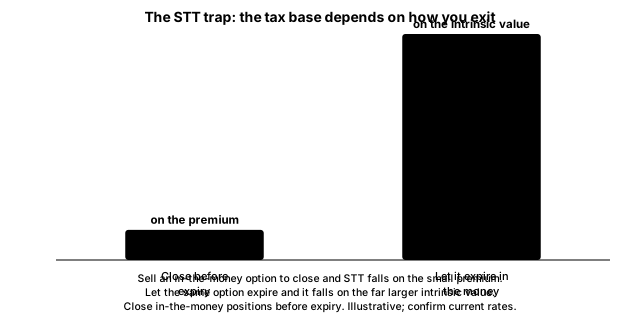
The sharpest Indian rule concerns what happens if you let an in-the-money option run all the way to expiry and be exercised, rather than selling it back in the market beforehand.
When you sell an option to close a position before expiry, STT is charged on the premium, a small amount. But when an in-the-money option is exercised at expiry, STT is charged on the option's intrinsic value, the amount by which it finished in the money, which for a deep in-the-money option is far larger than the premium ever was. Same option, a completely different tax base, depending only on whether you closed it or let it expire. This difference has a long and painful history in India, where traders would find the STT on an exercised option eating into, or even exceeding, the profit, and it is still large enough to matter today.
The practical rule is simple and worth making a habit: close your in-the-money options in the market before expiry rather than letting them be exercised. You pay the small STT on the premium instead of the larger STT on the intrinsic value, and you keep more of your profit. It is one of the few places where a pure piece of housekeeping, squaring off a day early, directly protects your returns.
Physical delivery on single-stock options
There is a second reason to close before expiry, and it applies only to single-stock options. In India, index options like NIFTY and Bank Nifty settle in cash: at expiry, any value is simply paid or received. But single-stock options are physically settled. If you hold an in-the-money stock option to expiry, you do not just receive a cash difference; you are obligated to take or give actual delivery of the shares, which means finding the full contract value in cash for a bought call exercised, or delivering stock for a call assigned against you. Brokers also raise margins sharply on stock options in the days before expiry to reflect this.
For a beginner running a strategy on a single stock, this can be an unpleasant surprise: a modest options position that, left to expire in the money, suddenly demands lakhs in delivery obligations. The rule again is to close single-stock option positions before expiry unless you genuinely intend to take or make delivery and have the cash to do so. This is also why so many beginners start with index options, where settlement is clean cash and there is no delivery to manage.
What to carry forward
The clean payoff diagram is the best case of a costless world, and the real market is not costless. Brokerage, exchange and SEBI charges, GST, stamp duty, STT, and the bid-ask spread all shave the profit and push the breakeven out, and they multiply with every leg, so simpler structures keep more of their edge. At expiry, two rules reward the same discipline: STT on an exercised in-the-money option falls on its intrinsic value rather than the premium, and single-stock options deliver real shares, so closing in the money before expiry is usually both cheaper and simpler. Confirm the live tax rates before trading, and remember this is education, not advice. The final chapter pulls the whole course together and walks you from the page into Niota's strategy builder and the practice sandbox.