Course contents
Being long without a plain call
A long future, a long synthetic future and a range forward all give you upside without buying a single call outright. Behind all three sits one idea, put-call parity, that a long call plus a short put equals being long the underlying.
- State put-call parity in plain words
- Build a long synthetic future and see it matches a long future
- Explain a range forward as a near-zero-cost bullish position and name its undefined downside
There is more than one way to be long NIFTY. The obvious way is to buy the future. The surprising way is to build the exact same exposure out of a call and a put. Once you see that a call and a put can add up to a future, a great deal of options structure clicks into place, and you gain a set of tools for taking full directional exposure without a plain call's decay. This chapter closes the bullish part with those tools, and with the identity underneath them.
Put-call parity
Here is the identity, first in pictures. Take a call and a put at the same strike and same expiry, say 24,000. Buy the call and you own all the upside above 24,000: as NIFTY rises, the call rises with it, point for point. Now sell the put at 24,000. Selling a put obligates you to buy at the strike, so you take on all the downside below 24,000: as NIFTY falls, the short put costs you, point for point. Own the upside and owe the downside, both from 24,000, and you have a position that gains one for one as NIFTY rises and loses one for one as it falls. That is precisely what being long the underlying does.
So, at the same strike and expiry, a long call plus a short put equals being long the underlying. This is put-call parity, one of the few near-certainties in options, held in place by the fact that if it drifted apart, traders would buy the cheap side and sell the dear side until it snapped back. Every structure in this chapter is that one identity, applied.
The buy future, for contrast
Before the synthetics, place the plain long future on the table, because it is what they copy. Buy the NIFTY future at 24,000 and your payoff is a single straight line through that price: profit one for one above, loss one for one below, with no ceiling and no floor. There is no premium and almost no time decay, which is the future's great advantage over a long call. Its price barely erodes as expiry nears. The cost is symmetry: you carry the full downside, and the position ties up margin, the SPAN plus exposure you met in Part 1, much as a naked option sale would. Its delta is one, its theta and vega about nothing. A future is pure, undecaying, two-sided direction. (Futures get a course of their own next; here they are the yardstick.)
The long synthetic future
Now build that same line out of options. A long synthetic future is a long call and a short put at the same strike and expiry. Buy the NIFTY 24,000 call at 150, and sell the 24,000 put at 150. The premiums cancel, so the net cost is about zero, and by parity the payoff is the future's straight line passing through 24,000.
See it in the numbers. If NIFTY finishes at 23,500, the call expires worthless and the short put costs you 500, for minus 500. At 24,000, both expire worthless, for zero. At 24,500, the call is worth 500 and the put expires worthless, for plus 500. Minus 500, zero, plus 500: exactly a long future entered at 24,000. The two options have become one future.
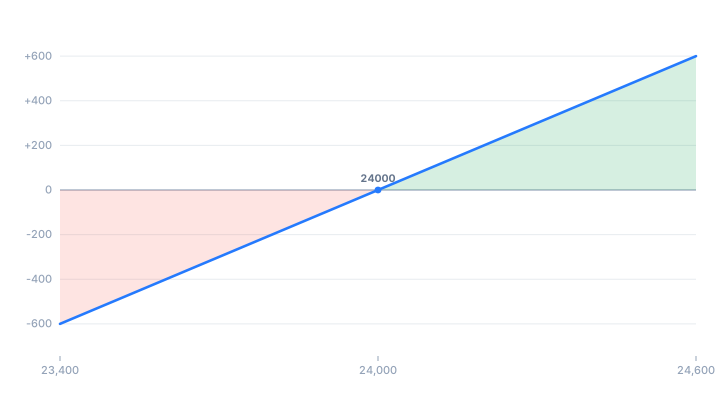
Why build a future from options instead of just buying the future? Sometimes the synthetic ties up less margin, or lets you enter at a strike you prefer, or captures a small pricing gap when the call and put stray from parity, which is a classic low-risk arbitrage for professionals. For a learner, its real value is as proof that the identity is true and usable. What matters for risk is that it contains a short put, so it carries the full downside and needs margin, exactly like the future it mimics. Its delta is one; it is not a limited-risk trade.
The range forward
The synthetic future used one strike. Spread the two options to different strikes and you get a cheaper, gentler cousin: the range forward. Buy an out-of-the-money call and sell an out-of-the-money put, one above the price and one below, arranged for little or no cost.
Buy the NIFTY 24,200 call at 70, and sell the 23,800 put at 80. You receive 80 and pay 70, a small net credit of 10 points, so it is effectively free to put on. The payoff now has a flat middle. Between 23,800 and 24,200, neither option is in the money and you simply sit on your small credit. Above 24,200, the call takes over and you gain like a future. Below 23,800, the short put takes over and you lose like one. There is a breakeven around 23,790 on the downside; below it the losses grow and, through the short put, they grow large.
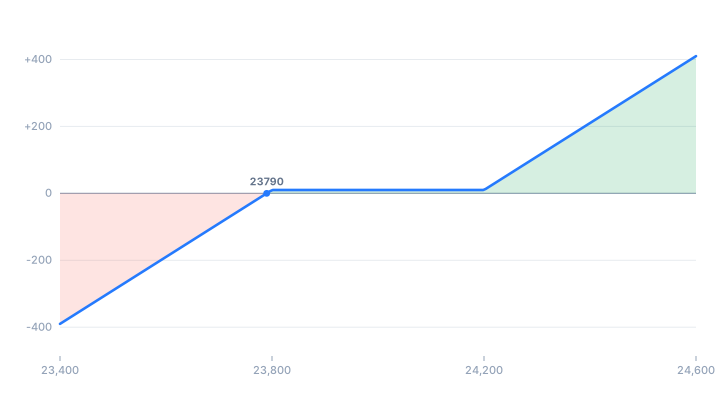
So a range forward is a bullish position that hands you the upside above a level in exchange for taking on the downside below another level, with a quiet band in the middle where nothing much happens. It suits a trader who is bullish, wants cheap or free upside participation, and is genuinely willing to be long from 23,800 if the market falls there, perhaps because they would have bought that dip anyway. It is the bullish sibling of the risk reversal you will meet in Part 3, which flips the two legs to lean bearish.
Zero cost is not zero risk
The range forward's near-free entry is its most dangerous feature, because "zero cost" is so easily misheard as "low risk." It is not a cheap directional bet like a long call. It contains a sold put, so below 23,800 your loss grows point for point with no natural floor until the market stops falling, and the position ties up margin the whole time. The same is true of the synthetic future and its short put. These structures give you full long exposure, downside included, and the absence of an upfront premium simply means you have paid with risk instead of cash.
What to carry forward
Being long has more than one shape. Put-call parity is the key: a long call plus a short put at one strike is simply being long the underlying, so calls, puts, and futures are three views of one thing. A long synthetic future rebuilds a long future exactly from a call and a put. A range forward spreads those legs apart for a near-free, bullish position that gives you the upside for taking on the downside below a level, with a quiet band between. All of them carry a sold leg, real downside, and margin, so none is a limited-risk trade. That completes the eleven bullish structures. Part 3 turns the whole toolkit downward, and because every bearish strategy is the mirror of one you now know, it will move quickly, starting with the two ways to be bearish, one of them the most dangerous single leg in options.