Course contents
Long straddle, long strangle, strap and strip
A long straddle or strangle buys both a call and a put, so it profits from a large move in either direction and does not care which way. A strap leans the bet bullish, a strip leans it bearish. Time decay is the price of waiting.
- Build a long straddle and long strangle and see that the move must beat the combined premium
- Add a directional lean with a strap or a strip
- Explain why time decay and a fall in volatility are the enemy of every long-volatility trade
Part 4 sold calm and feared the storm. Part 5 does the opposite: it pays for the storm and fears the calm. These are the big-move strategies, the ones you reach for when you are sure the market is about to move hard but genuinely do not know which way. In the app they sit under the Others tab, but they share one plain purpose, and it is the exact opposite of the neutral strategies you just met. The good news is that you are the buyer again, so your loss is capped at what you pay. The new enemy is the one every buyer faces: time.
The long straddle
A long straddle is the mirror of the short straddle from Part 4. Instead of selling the at-the-money call and put, you buy them. On NIFTY at 24,000, buy the 24,000 call at 150 and the 24,000 put at 150, paying a net debit of 300 points, 19,500 rupees. (All figures illustrative.)
Everything about the short straddle now flips. Your max loss is the 300 you paid, suffered if NIFTY finishes exactly at 24,000, where both options expire worthless. Your breakevens are 23,700 and 24,300, the strike plus and minus the premium. Your max profit is unlimited, growing in either direction once NIFTY travels beyond a breakeven. The payoff is a valley: a loss centred on the strike, climbing into profit on both sides.
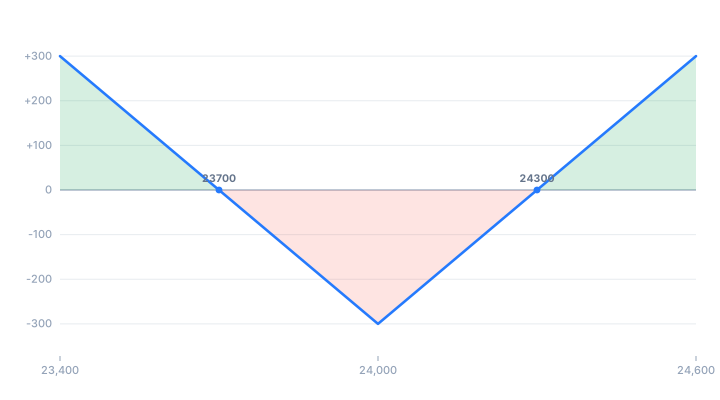
The same insight from the short straddle applies, reversed. The 300 you paid is roughly the move the market already expects, so buying it is a bet that the real move is even bigger. You do not just need NIFTY to move; you need it to move more than 300 points, and to do so before time runs out. The Greeks confirm the trade: delta-neutral, so direction alone does nothing; long vega, so you gain if implied volatility rises; and negative theta, so every quiet day costs you. Where the seller lived on time decay, the buyer bleeds from it.
The long strangle
A long strangle is the cheaper, wider cousin, the mirror of the short strangle. Buy the 24,200 call at 70 and the 23,800 put at 80, a net debit of 150. It costs half the straddle because both options are out of the money, but it asks for a bigger move to pay off. Your max loss is 150 anywhere between 23,800 and 24,200, your breakevens are 23,650 and 24,350, and your max profit is unlimited beyond them. The straddle is dearer but starts earning sooner from the strike; the strangle is cheaper but needs a larger move to clear its wider breakevens.
The strap and the strip: a lean on top
The straddle and strangle are perfectly balanced: they do not care whether the move is up or down. But often you expect a big move and lean one way. The strap and strip add that lean by doubling one leg.
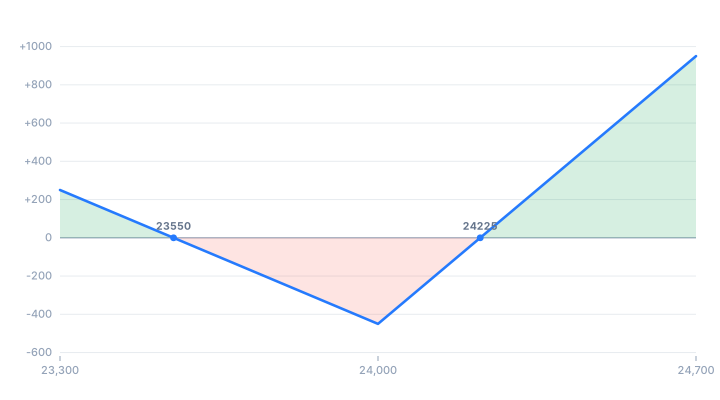
A strap buys two calls and one put at the same strike: on NIFTY, two 24,000 calls at 150 each and one 24,000 put at 150, a net debit of 450. It still profits from a move either way, but twice as fast upward, because you hold two calls. That shows up in the breakevens. On the downside you need the full 450 points of fall to break even, reaching 23,550, but on the upside you only need half that, because two calls share the load, so the upper breakeven is just 24,225. It is a volatile bet with a bullish tilt: big move likely, more likely up.
A strip is the mirror, buying two puts and one call, a net debit of 450 as well. Now the lean is bearish: the lower breakeven is only 23,775, while the upper needs the full move to 24,450. Same idea, pointed down: big move likely, more likely down.
The enemy is time, and the event trap
Every strategy in this chapter buys options, so every one of them loses value each day the market sits still, and each one wants a rise in implied volatility. That combination sets a specific trap that catches many beginners, and it is the exact counterpart of the short straddle's steamroller.
The trap is buying a straddle just before a big scheduled event, expecting the event to move the market. The problem is that everyone else expects it too, so implied volatility is already high and the straddle is already expensive, pricing in a large move. When the event passes, that volatility collapses, a drop often called the volatility crush, and the premium you paid deflates with it. The market can move a fair amount in your direction and you can still lose, because you overpaid for a move the market had already priced. Being right that it moves is not enough; it has to move more than the rich premium implied, and fast.
What to carry forward
The big-move strategies buy volatility: a long straddle and strangle profit from a large move in either direction, with the loss capped at the premium and the profit open-ended, while time decay and falling volatility work against you the whole time. A strap tilts the bet bullish and a strip tilts it bearish by doubling one leg. All four need a move larger than the premium, arriving before the clock and the volatility crush drain it. The next chapter caps both the cost and the profit of these trades, giving you the long iron butterfly and long iron condor, the debit mirrors of the range sellers from Part 4.