Course contents
Direction and volatility, the two questions
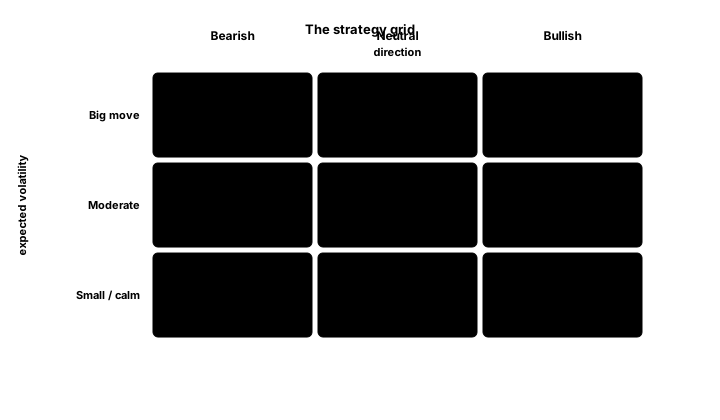
Every strategy is a bet on two things at once, which way the underlying goes and how far it moves. A simple grid of direction against volatility sorts every strategy in this course.
- Place any market view on a direction-by-volatility grid
- Explain that options let you bet on volatility itself, not only direction
- Use the grid to point from a view to a family of strategies
Two traders look at NIFTY on the same morning. Both say the same three words: "I am bullish." The first buys a call. The second sells a put. Two weeks later NIFTY has drifted up by a slow 150 points, exactly the gentle rise both expected. The first trader, the one who was bullish and right, has lost money. The second, equally bullish and equally right, has made money.
How can the same view produce opposite results? Because "I am bullish" was only half of what each trader believed. The half they left unspoken decided who won. That missing half is volatility: not which way NIFTY moves, but how much and how fast.
Two questions, not one
Every options strategy answers two questions at the same time.
The first is direction. Do you think the underlying goes up, goes down, or stays roughly where it is? Call that bullish, bearish, or neutral.
The second is volatility. Do you think the underlying makes a big move, or stays quiet and barely moves? A big, fast swing in either direction is high volatility. A slow drift or a flat, boring range is low volatility. In Options Basics you met implied volatility, the market's own expectation of how much the underlying will move, priced into every premium through vega. That expectation is what you are betting for or against.
Stocks only really offer the first question. You are long, or you are short. Options offer both, and that is what makes them worth the trouble. You can bet on a big move without knowing its direction. You can bet that nothing happens. You can be bullish and betting on calm, or bullish and betting on a storm, and those are different trades that need different structures.
Go back to the two traders. The call buyer needed a move large enough to beat the premium and the daily time decay. A slow 150-point drift was not enough, so being right on direction did not save the trade. The put seller collected premium up front and only needed NIFTY to stay above the strike. The same slow drift, plus the quiet that let time decay do its work, paid the seller. One was long a big move, the other short it. Volatility, not direction, split them.
The grid
Lay the two questions on two axes and you get a grid. Direction runs left to right: bearish, neutral, bullish. Volatility runs bottom to top: you expect a small move, or you expect a big one. Every strategy in this course lives in one of the boxes, and once you know your box, you have already narrowed 38 strategies down to a handful.
Walk the boxes in plain terms.
If you are bullish and expect a big up-move, you want to own upside: a long call, a bull call spread, a call ratio back spread. Time and a wrong guess are the risks.
If you are bullish but expect a slow, quiet rise, buying is the wrong side of time decay. You would rather collect premium: sell a put, or run a bull put spread for a credit. Now time is working for you.
The bearish side mirrors this exactly. Expecting a sharp fall points you to long puts and bear put spreads. Expecting a slow, quiet slide points you to selling calls with defined risk, collecting premium as the market sags.
If you are neutral and expect calm, you think the underlying sits inside a range and volatility fades. You sell that quiet: short straddles and strangles, iron condors, iron butterflies. You are paid to be right that nothing much happens.
If you are neutral on direction but expect a big move, you have no idea which way, only that it will be violent, perhaps around a major event. You buy that: a long straddle or strangle profits from a large move either way. Direction does not matter; size does.
You do not need to memorise which strategy sits in which box yet. You need the habit of asking both questions before you reach for any structure.
Why the quiet half is where beginners lose
Most newcomers bet direction and ignore volatility entirely. They buy a call because they feel bullish, and they never ask whether the move they expect is big enough, and soon enough, to beat what the premium already prices in. This is why so many option buyers are "right" and still lose. The stock went their way, just not far enough or fast enough to clear the volatility bar baked into the price.
The clearest case is a known event. Before a big scheduled event, say a monetary policy decision or a heavy expiry week, implied volatility runs high and options turn expensive, because everyone expects a move. Suppose NIFTY sits at 24,000 and a one-week straddle, the call plus the put at 24,000, together costs 300 points. That price is the market telling you it expects a move of roughly 300 points by expiry. If you buy that straddle, you do not profit unless NIFTY finishes above 24,300 or below 23,700. A 200-point move, large by most weeks' standards, still loses you money, because you paid for 300. You were right that it would move. You were wrong that it would move enough. (Figures are illustrative.)
What to carry forward
A market view has two parts, not one: direction, which way, and volatility, how much. Options let you bet on either or both, which is their whole advantage over simply buying or selling the underlying. Place your view on the grid, direction across and expected volatility up, and you have already chosen a small family of strategies and ruled out the rest. Carry the two traders with you as a warning: being right on direction while wrong on volatility is the standard way to lose. Next, you will learn to read the picture that shows a strategy's whole outcome at a glance, the payoff diagram, using Niota's strategy builder to draw it.