Course contents
Long iron butterfly and long iron condor
A long iron butterfly and a long iron condor are the capped-cost way to bet on a big move. You pay a known debit and profit if the underlying breaks out of a middle band, giving up the open-ended profit of a plain straddle in return for a lower cost.
- Build the long (debit) iron butterfly and iron condor
- Contrast them directly with the short (credit) versions from Part 4
- Say when a defined-cost breakout bet is better than a plain long straddle
The long straddle had an uncapped profit and a real cost, 300 points, most of which you lose if the market sits still. What if you wanted the same big-move bet but were willing to trade away the unlimited upside for a lower price? That is exactly what a bought vertical did to a bought call in Part 2, and the same move works here. Sell a far option on each side of your straddle, and you cheapen it, at the cost of capping how much it can make. What you get are the long iron butterfly and the long iron condor, the debit mirrors of the range sellers you met in Part 4.
The long iron butterfly
Start from the long straddle, buying the NIFTY 24,000 call and put for 300. Now sell the 24,200 call at 70 and the 23,800 put at 80, taking in 150. Your net debit falls to 150 points instead of 300. You have built a long iron butterfly, a long straddle wrapped in sold wings.
This is the exact inverse of the iron butterfly from Part 4, on the same strikes, with the payoff flipped top to bottom. Your max loss is the net debit, 150, suffered at 24,000 where everything expires worthless. Your breakevens are 23,850 and 24,150. And your max profit is the width minus the debit, 200 minus 150, which is just 50 points, reached once NIFTY moves out past either wing. Where the short iron butterfly made 150 at the centre and lost 50 at the wings, the long one loses 150 at the centre and makes 50 at the wings.
Be honest about that ratio: you are risking 150 to make 50. That is the price of a tight long iron butterfly, and it is why the structure is a niche one. You buy it only when you want a defined cost, expect a move out to roughly the wings, and are content with a capped, modest profit rather than the straddle's open-ended one. It profits from a moderate breakout, not a moonshot, because beyond the wings the profit stops.
The long iron condor
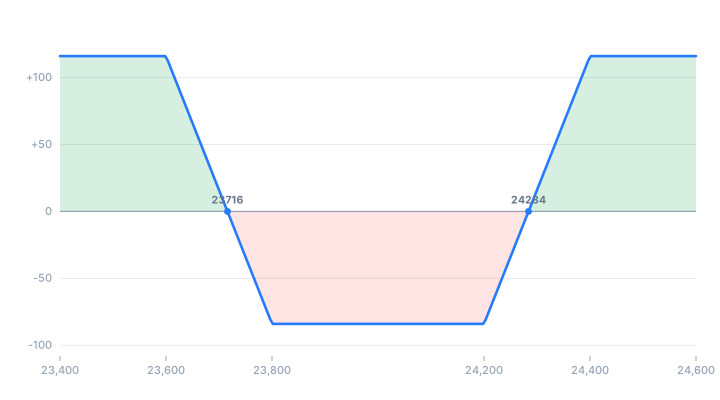
The long iron condor does the same to a long strangle, and its numbers are friendlier. Buy the 24,200 call at 70 and the 23,800 put at 80, then sell the 24,400 call at 28 and the 23,600 put at 38. Your net debit is 84 points. It is the inverse of the short iron condor from Part 4: your max loss is 84 across the middle band from 23,800 to 24,200, your max profit is the width minus the debit, 200 minus 84, which is 116 points, reached beyond the outer wings, and your breakevens are 23,716 and 24,284.
Here you risk 84 to make 116, a better balance than the long iron butterfly, because the strikes are spread wider and the bought strangle is cheaper to begin with. The trade profits when NIFTY breaks out past a breakeven and runs toward a wing, and it caps out once it clears the outer strike.
When the capped version beats the straddle
These structures are to the long straddle and strangle what a debit vertical is to a plain long call: cheaper, and capped. So when do you prefer the cap? When you expect a real but contained move, to about the wings, rather than a runaway one, and you would rather pay less for that specific outcome than pay full price for an open-ended bet you do not really expect to need. The lower debit also means less to lose if you are wrong and the market sits still, 84 or 150 instead of the straddle's 300.
The trade-off is symmetrical to the credit versions, so use the net-vega reading from Part 1 to keep them straight. The short iron condor is a credit, short-volatility, wants-calm trade. The long iron condor is a debit, long-volatility, wants-a-move trade. Same four strikes, opposite everything, and the word long or short in the name tells you which.
What to carry forward
The long iron butterfly and long iron condor bet on a breakout for a defined, limited cost, giving up the open-ended profit of a plain straddle in exchange. They are the debit mirrors of Part 4's range sellers: same strikes, flipped payoff, loss in the middle and capped profit at the wings. The condor's wider strikes usually give a better reward-to-risk than the butterfly's tight ones. Reach for them when you expect a contained move and want to pay little for the chance. The last strategy chapter returns to the ratio structures, but to their dangerous front-facing form, the call and put ratio spreads, whose credit hides a naked tail.