Course contents
Short straddle and short strangle
Selling a straddle or a strangle collects premium from both sides at once and profits if the underlying sits still. The profit is capped at what you collect, and the loss on either side is not capped at all.
- Build a short straddle and a short strangle and read their payoffs
- See the small capped profit against the uncapped loss on both wings
- Explain the margin they demand and why a gap or an event can be ruinous
Part 3 ended the directional strategies. Now direction drops away, and the question becomes only how much the market moves. The neutral strategies in this part profit when the underlying stays put and volatility fades, and the way you profit from stillness is by selling options to someone who is paying for movement. This is premium selling, and it is genuinely useful and genuinely dangerous, so this part carries the loudest warnings in the course. We start with the two purest, and riskiest, forms.
The short straddle
A short straddle sells a call and a put at the same strike, right at the current price. Sell the NIFTY 24,000 call at 150 and the 24,000 put at 150, and you collect 300 points, 19,500 rupees for a lot, the instant you enter. (All figures illustrative.)
You keep all of it only if NIFTY finishes exactly at 24,000, where both options expire worthless. Away from 24,000 in either direction, one of the two options finishes in the money and eats into your premium. Your max profit is the 300 you collected, at the strike. Your breakevens are the strike plus and minus that premium, so 23,700 and 24,300: anywhere between them at expiry you keep something, outside them you lose. And your max loss is unlimited, because above 24,300 the short call keeps costing you more the higher NIFTY goes, and below 23,700 the short put does the same all the way down.
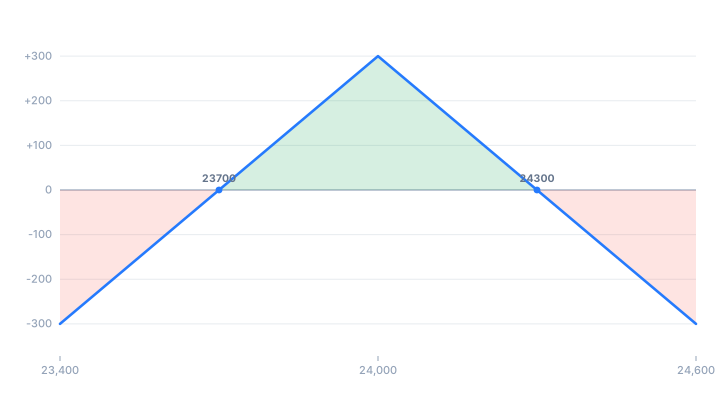
There is a sharp way to understand the 300 you collected. It is, roughly, the move the market already expects. Recall from Options Basics that an at-the-money straddle's price is the market's estimate of how far the underlying will travel by expiry. By selling it, you are betting the real move will be smaller than 300 points. You win if the market is calmer than it feared. You lose if it is wilder. The Greeks say the same: the position is delta-neutral, so small moves barely touch it; it has strong positive theta, so every calm day pays you; and it has strong negative vega, so a jump in implied volatility hurts you even before the price moves.
The short strangle
A short strangle widens the straddle by selling out-of-the-money strikes instead of the at-the-money one. Sell the NIFTY 24,200 call at 70 and the 23,800 put at 80, collecting 150 points. You collect less than the straddle, but you buy yourself a wider quiet zone. You keep the full 150 anywhere between 23,800 and 24,200, and your breakevens are 23,650 and 24,350. The payoff is a flat profit plateau across the middle rather than a single peak, and, exactly as with the straddle, the max loss is unlimited beyond the breakevens.
So the two trade off against each other cleanly. The straddle collects more (300) but is right only in a narrow band and peaks at a single point. The strangle collects less (150) but is right across a wider band. Both are delta-neutral, both live on positive theta and short volatility, and both share the one feature that should never leave your mind: the loss on each side has no floor.
Picking up coins in front of a steamroller
In a calm market these trades feel like the easiest money in options. You sell premium, the days pass, theta pays you, and you do it again. That steady drip is exactly what makes them dangerous, because it tempts you to size up, right until the day the market gaps. Sell the 24,000 straddle for 300, and if a surprise result or a global shock opens NIFTY at 24,800, your short call is worth 800, you are down 500 on a trade that could only ever have made 300, and if the move extends you keep losing. The steamroller does not arrive often. It only has to arrive once.
Two practical truths follow. First, the margin is heavy, the SPAN plus exposure of Part 1, and it can be increased or called in the middle of a bad move, forcing you out at the worst possible moment. Second, the risk is worst around scheduled events, when implied volatility is high and tempting to sell, but precisely because a large move is genuinely more likely.
What to carry forward
The short straddle and short strangle are the purest way to sell calm: collect premium up front, profit from time decay and falling volatility if the underlying stays in a range, and face an unlimited loss if it does not. The straddle is the narrow, higher-premium version peaking at one strike; the strangle is the wider, lower-premium version with a flat top. Their shared flaw is the uncapped loss, and the fix is simple and worth its cost: buy a cheap wing on each side. The next chapter does exactly that, turning these two into the iron butterfly and the short iron condor, where the loss becomes a small, known number and the margin falls with it.