Course contents
Batman and double plateau
A Batman and a Double Plateau both aim to profit from a range, but with two humps rather than one. A Batman stacks a call ratio spread and a put ratio spread and keeps a naked tail on each side. A Double Plateau joins a bull condor and a bear condor for a fully capped, two-plateau version.
- Read a two-peaked payoff
- Build a Batman and locate its undefined-risk wings
- Build a Double Plateau and see it is defined-risk throughout, then tell the two apart by their risk
The iron butterfly and condor had a single profit zone. The two structures in this chapter have two, a payoff with a pair of humps, one on each side of the current price. They look almost like twins on a chart, and traders often confuse them, but they are built from different parts and carry opposite risks. Learning to tell them apart is the real lesson here, and it is a direct test of everything Part 1 taught about reading a payoff and naming a naked leg.
The Batman
The Batman gets its name from its silhouette: two peaks with a dip between them, like the ears on the mask. You build it by stacking two ratio spreads, one in calls above the price and one in puts below.
On the call side, buy one NIFTY 24,100 call at 105 and sell two 24,200 calls at 70 each. On the put side, buy one 23,900 put at 110 and sell two 23,800 puts at 80 each. Adding the four legs, you take in more than you pay, a net credit of about 85 points. (All figures illustrative.) Selling two options and buying one on each side is what makes each half a ratio spread, and it is also where the danger hides.
Trace the payoff. Across the middle, near 24,000, you sit on a modest profit of about 85, the credit you kept. As NIFTY drifts toward either sold strike, the profit rises to a peak of 185 at 24,200 on the upside and again at 23,800 on the downside: those are the two humps. But past each hump the trade turns, because on each side you sold two options and own only one, leaving a single naked option on each wing. Above roughly 24,385 and below roughly 23,615 you cross into loss, and that loss has no floor: above 24,200 the extra short call runs against you without limit, and below 23,800 the extra short put does the same. So the Batman profits across a wide central range, best at the two sold strikes, and carries an unlimited loss on both wings.
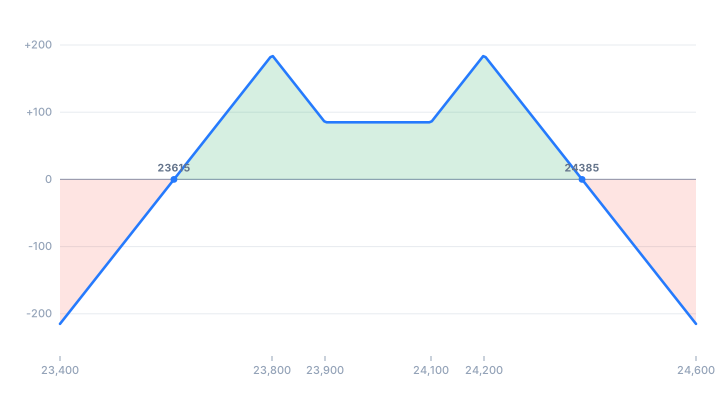
Read the Greeks and it is a net seller: positive theta, and it gains if volatility falls, because you sold more than you bought. It is a rangebound, income-flavoured trade with a wide comfort zone. But the two naked wings make it, at heart, as dangerous as the naked strangle from two chapters ago, dressed up in a cleverer shape.
The Double Plateau
The Double Plateau produces a similar two-humped look, but every leg is covered, so nothing is left naked. You build it by joining two structures you already know from the directional parts: a bull condor above the price and a bear condor below it.
Above, the bull condor: buy the 24,100 call at 105, sell the 24,300 call at 45, sell the 24,500 call at 18, buy the 24,700 call at 8. Below, the bear condor: buy the 23,900 put at 110, sell the 23,700 put at 55, sell the 23,500 put at 25, buy the 23,300 put at 12. Across all eight legs you pay a net debit of about 92 points, and that debit is your maximum loss.
The payoff has two flat profit plateaus, hence the name. Between 24,300 and 24,500 the position pays a plateau of about 108, and between 23,500 and 23,700 it pays the same 108 on the downside. But look at the middle: right around 24,000, where the market started, the position sits at its maximum loss of 92, because both condors expire worthless there. And far out, beyond 24,700 or below 23,300, it returns to that same capped 92 loss. So the Double Plateau does not want the market to sit still. It wants a moderate move to one side or the other, into one of its plateaus, and it loses its capped debit if the market either stalls at the centre or breaks far away.
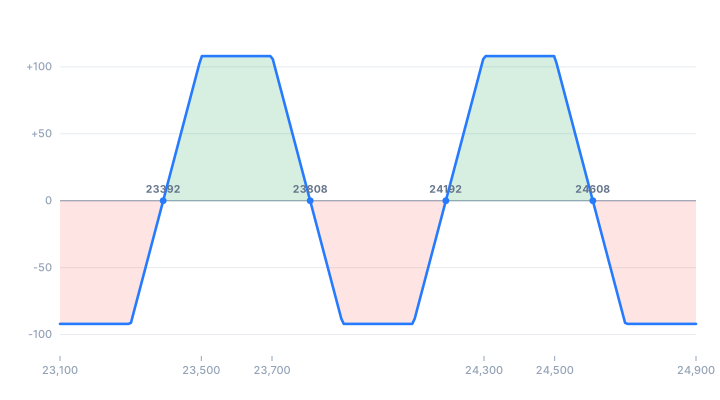
Every outcome is a finite number. The bought condor wings cap both sides, so unlike the Batman, there is no naked tail anywhere. It is fully defined risk.
Same silhouette, opposite trades
Here is the distinction to carry, because the charts tempt you to treat them as the same trade. They are not, in two ways.
They disagree about risk. The Batman collects a credit but keeps a naked option on each wing, so a breakout brings an unlimited loss. The Double Plateau pays a debit and caps every outcome, so its worst case is the debit and nothing more. Credit with open tails, or debit with closed ones.
And they disagree about stillness. The Batman is profitable across its whole central range, so it is a bet that the market stays roughly rangebound. The Double Plateau loses at the centre and pays only in its two plateaus, so it is a bet that the market makes a moderate move to one side, direction unknown. One wants calm; the other wants a contained move.
What to carry forward
Two structures, two humps, opposite risks. The Batman is two ratio spreads: a net-credit, rangebound trade with peaks at the sold strikes and an unlimited loss on each naked wing. The Double Plateau is a bull condor plus a bear condor: a net-debit, fully capped trade that profits from a moderate move to either side and loses its small debit if the market sits still or runs too far. Tell them apart by asking two questions you now know to ask: is there a naked leg, and does the trade want stillness or a move. The last neutral chapter keeps the premium-selling theme but removes the risk on one whole side by design, giving you the jade lizard and its reverse.