Course contents
The remaining bearish structures, mirror by mirror
The put ratio back spread, the long put calendar, the bear butterfly and the bear condor each mirror a bullish structure already learned. Meeting them together, as reflections, shows how a single idea reappears pointed downward.
- Recognise each of the four as the bearish mirror of a bullish structure from Part 2
- Read their payoffs, including the back spread's loss zone and the targeted plays' profit zones
- Say when a targeted bearish bet beats a plain long put
Four bearish structures remain, and you have effectively met all of them already, because each is a bullish structure from Part 2 held up to a mirror. Rather than teach them from scratch, this chapter walks each one as a reflection: name the bullish twin, flip it, and read off the card. If a payoff here feels familiar, that is the point.
The put ratio back spread
Mirror of the call ratio back spread. There you sold one call and bought two higher calls for a bullish breakout; here you sell one put and buy two lower puts for a bearish breakdown. Sell one NIFTY 24,000 put at 150, and buy two 23,800 puts at 80 each. You receive 150 and pay 160, a near-costless entry, here a tiny net debit of 10 points. As before, you own more options than you sold, which keeps the risk defined and makes you long volatility. (All figures illustrative.)
Its payoff has the same three regions as its bullish twin, flipped. If NIFTY rises above 24,000, all three puts expire worthless and you lose only the 10-point debit. If NIFTY falls modestly and stalls near 23,800, you are in the loss valley, worst at 23,800 where the position loses 210 points, the max loss. If NIFTY falls hard past 23,590, the two puts you own outrun the one you sold and your profit grows as the market drops, all the way down. Between roughly 23,590 and 24,000 you are in the red, deepest at 23,800.
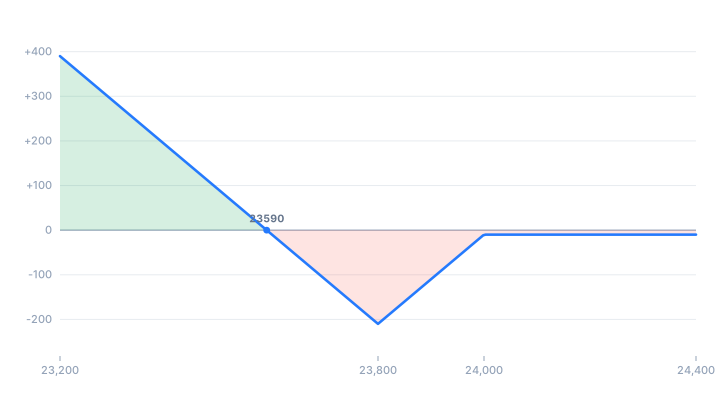
Read the Greeks and it is the call back spread reflected: net negative delta, net long vega, net negative theta. A bearish, long-volatility, breakdown trade, defined-risk, whose worst outcome is a timid fall that stalls at the long strike. Use it when you expect a large, fast drop, not a gentle slide.
The long calendar with puts
Mirror of the long call calendar, and mechanically almost the same trade, because a calendar barely cares about direction. Sell a near-dated put and buy a far-dated put at the same strike, set a little below the current price for a mild bearish lean. Sell this week's 23,900 put at 55, and buy next month's 23,900 put at 190, a net debit of 135 points, which is your maximum loss. (Two-expiry figures illustrative.)
Everything you learned about the call calendar carries over. The near put you sold decays faster than the far put you own, so if NIFTY sits near 23,900 as the near expiry arrives, you keep the near premium and hold a far put bought at a discount. The payoff is the same tent, now centred on 23,900. A big move either way, or a fall in implied volatility, collapses it back toward the debit. And the signature Greeks are unchanged: net positive theta and net positive vega, paid to wait and helped by rising volatility, as long as the price stays near the strike in the near term.
The bear butterfly
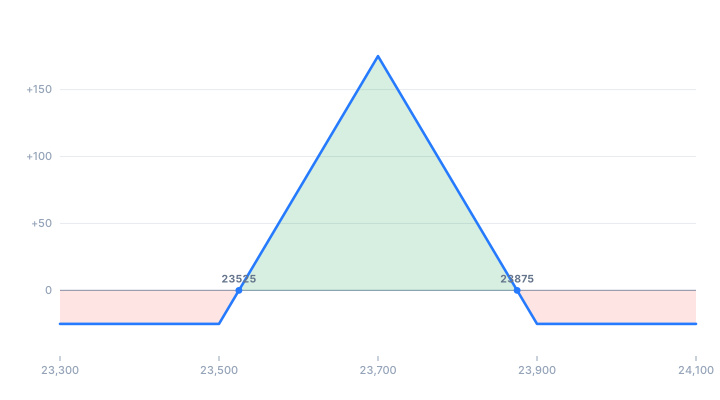
Mirror of the bull butterfly, built from puts and pitched below the price. Buy one put at a higher strike, sell two at a middle strike, buy one at a lower strike, equally spaced, with the middle at your target. Buy the NIFTY 23,900 put at 110, sell two 23,700 puts at 55 each, and buy the 23,500 put at 25. The cash is a net debit of 25 points, just 1,625 rupees.
Its card mirrors the bull butterfly exactly. The max loss is the debit, 25 points, above 23,900 or below 23,500. The max profit is the adjacent-strike gap minus the debit, 200 minus 25, which is 175 points, reached at 23,700, your target. The breakevens are 23,875 and 23,525, and the payoff is a tent peaking at 23,700. It is cheap, defined-risk, and short volatility, and it carries the same honest catch: a wonderful reward-to-risk of seven to one that reflects a low chance of finishing in the narrow zone.
The bear condor
Mirror of the bull condor, the butterfly's peak pulled into a plateau. Buy the NIFTY 23,900 put at 110, sell the 23,700 put at 55, sell the 23,500 put at 25, and buy the 23,300 put at 12, a net debit of 42 points. The max loss is the debit, 42 points, above 23,900 or below 23,300. The max profit is 158 points, held flat across the band from 23,500 to 23,700. The breakevens are 23,858 and 23,342. It gives you a wider zone to be right in than the butterfly, for a higher cost and a lower peak.
When a targeted bearish bet beats a plain put
The butterfly and condor answer a question the long put cannot. A long put profits more the further NIFTY falls, so it suits a "crash" view with no floor in mind. But often your bearish view has a target: you expect NIFTY to fall to a support level around 23,700 and steady there, not to collapse. Paying 150 for a put that keeps needing the market lower is the wrong tool for that view. A bear butterfly centred at 23,700 costs a fraction, pays well if the market lands where you expect, and does not depend on a crash that you do not actually foresee. The targeted structures are for a precise fall; the long put and the back spread are for an open-ended one. This is education, not advice.
What to carry forward
Four structures, four reflections, no new ideas. The put ratio back spread is a defined-risk, long-volatility bet on a sharp fall, worst at a timid dip. The long put calendar is the call calendar with a bearish tilt, positive theta and positive vega, wanting near-term calm. The bear butterfly and bear condor are cheap, defined-risk bets that the fall lands on a strike or across a band, the right tool when your bearishness has a target. That completes the structured bearish plays. The last bearish chapter mirrors the synthetics, being short without a plain put, and returns to put-call parity pointed downward.