Course contents
Being short without a plain put
A short future, a short synthetic future and a risk reversal give you downside exposure or downside protection built from calls and puts. Parity mirrors again, that a short call plus a long put equals being short the underlying.
- Build a short synthetic future and see it matches a short future
- Explain a risk reversal as protection paid for by selling the upside, and name its undefined risk
- Connect all three back to put-call parity
The bullish part closed with synthetics: being long built out of a call and a put. The bearish part closes the same way, in the mirror. Being short also has more than one shape, and the identity underneath is the same put-call parity you already know, simply pointed downward. This chapter finishes the twenty-two directional strategies and hands you the last two synthetics, along with an honest look at the risk they carry.
Parity, pointed down
Recall the identity from the bullish synthetics chapter: at one strike and expiry, a long call plus a short put is being long the underlying. Flip every leg and you flip the position. A short call plus a long put, at the same strike and expiry, is being short the underlying. The short call hands away all the upside above the strike, the long put keeps all the downside below it, and together they lose one for one as the market rises and gain one for one as it falls, exactly like a short position. Parity holds in both directions, and the two bearish synthetics here are just that mirror identity, applied.
The sell future, for contrast
Place the plain short future on the table first, as the yardstick. Sell the NIFTY future at 24,000 and your payoff is a straight line sloping down: profit one for one as NIFTY falls, loss one for one as it rises, with no floor to the profit and, crucially, no ceiling to the loss. Like its long twin it barely decays and pays no premium, and it ties up margin. But note the danger it shares with the naked short call: because the market can rise without limit, a short future carries a truly unlimited loss. Selling the future, like selling a naked call, is a position that a rising market can punish without bound. (Futures get their own course next; here they set the reference.)
The short synthetic future
Now rebuild that short future from options. A short synthetic future is a short call and a long put at the same strike and expiry. Sell the NIFTY 24,000 call at 150, and buy the 24,000 put at 150. The premiums cancel, so the net cost is about zero, and by parity the payoff is the short future's downward line through 24,000.
The numbers confirm it. If NIFTY finishes at 23,500, the short call expires worthless and the put you own is worth 500, for plus 500. At 24,000, both expire worthless, for zero. At 24,500, the put expires worthless and the short call costs you 500, for minus 500. Plus 500, zero, minus 500: exactly a short future entered at 24,000. Its max profit is large, growing as NIFTY falls toward zero, and its max loss is unlimited, because the short call has no ceiling. Its delta is minus one.
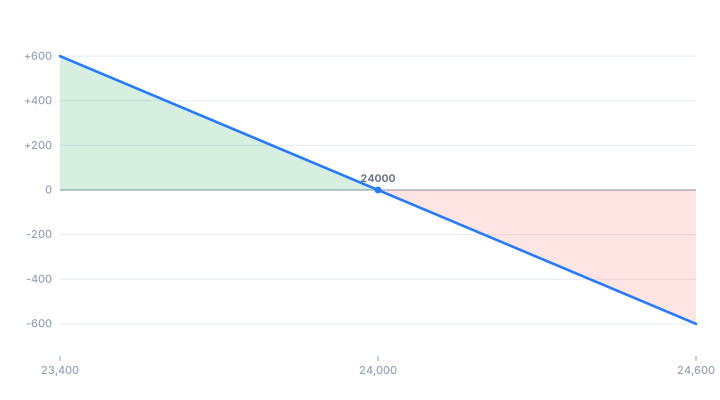
Why build it from options rather than sell the future? The same reasons as the long version: it can be cheaper on trading cost, it can capture a small parity mispricing, and in India the securities transaction tax on options can work out lower than on futures for the same exposure. What matters for risk is that it contains a naked short call, so it carries the same unlimited upside loss as a short future and needs margin. It is not a limited-risk trade.
The risk reversal
Spread the two legs to different strikes and you get the bearish mirror of the range forward: the risk reversal. Where the range forward bought a call and sold a put to lean long, the risk reversal sells a call and buys a put to lean short. Sell the NIFTY 24,200 call at 70, and buy the 23,800 put at 80. You receive 70 and pay 80, a near-zero cost, here a tiny debit of 10 points.
The payoff has the range forward's flat middle, reflected. Between 23,800 and 24,200, neither option is in the money and you sit on your small cost. Below 23,800, the put you own takes over and you profit as the market falls, with a breakeven around 23,790. Above 24,200, the short call takes over and your loss grows without limit. So the max profit is large on a fall, and the max loss is unlimited on a rise, through that short call.
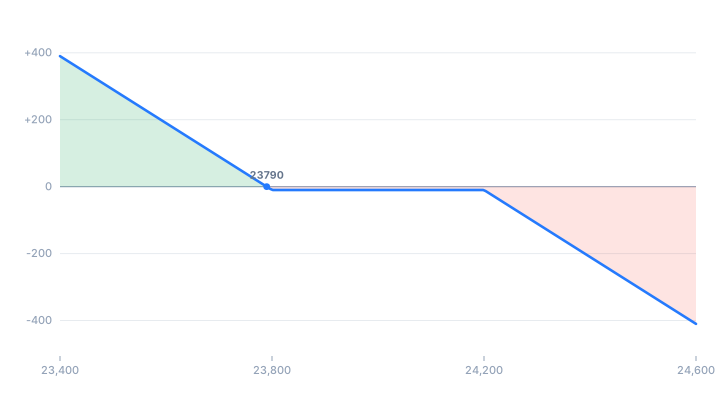
The risk reversal has a second life that is worth knowing, because it is where the structure is most sensible. Placed over shares you already own, it becomes a collar: you own the stock, you buy a put to protect the downside, and you sell a call to pay for that put. Now the short call is covered by the stock you hold, so its unlimited risk is gone, and what you have is a holding with a floor under it and a ceiling over it, arranged for little or no cost. The bought put is your insurance; the sold call is how you finance it, at the price of capping your upside. Used this way, over a position you own, the risk reversal is a careful protective structure. Used naked, as a pure bearish bet, it carries the short call's open-ended risk.
Zero cost is not zero risk, again
The warning from the bullish synthetics returns with more force, because here the open side is the upside, and a rising market has no ceiling. A short synthetic future and a naked risk reversal both contain a short call, so both can lose without limit if the market climbs, and both tie up margin the whole time. Their near-free entry is not a discount on risk; it is risk taken in place of cash. The only version here with defined risk is the risk reversal held as a collar against stock you actually own, where the shares cover the call.
What to carry forward
Being short, like being long, has several shapes, all held together by put-call parity: a short call plus a long put at one strike is simply being short the underlying. A short synthetic future rebuilds a short future exactly. A risk reversal spreads the legs for a near-free bearish position, or, over a holding you own, becomes a collar that protects the downside and finances it by capping the upside. Every one of them contains a short call and so carries unlimited risk unless that call is covered. That completes the twenty-two directional strategies, eleven up and eleven down. Part 4 leaves direction behind for the neutral strategies, where you profit not from a move but from its absence, and where the honest warnings you have been reading grow loudest, because selling calm is where the largest hidden risks live.