Course contents
Adding a volatility and time view
A call ratio back spread and a long call calendar are still bullish, but they also take a side on volatility and on time. The back spread wants a big move up; the calendar wants a slow drift and a rise in volatility.
- Read a call ratio back spread's payoff, including its middle loss zone and its open-ended profit on a large up-move
- Explain how a long calendar earns from near-term time decay and a rise in implied volatility
- See why both are bullish and volatility bets at once
The vertical spreads were pure direction with volatility mostly netted out. The two structures in this chapter are different. They are still bullish, but each one also takes a deliberate side on volatility and on time, which makes them sharper tools for a particular kind of bullish view and worse tools for the wrong one. This is where the grid's second axis, how much the market moves, starts to drive the choice.
Both are a step up in complexity, so read them slowly and lean on the net Greeks from Part 1 to keep your bearings.
The call ratio back spread
Start with a strongly bullish view: you think NIFTY does not just drift up, it breaks out and runs. A plain call would work, but it decays while you wait for the break. The call ratio back spread shapes that view by selling one call at a lower strike to help pay for two calls at a higher strike.
Sell one NIFTY 24,000 call at 150, and buy two 24,200 calls at 70 each, which costs 140. You receive 150 and pay 140, a small net credit of 10 points. Notice you now own more calls than you sold, two against one, which is what makes it a "back" spread and, as you will see, gives it a defined risk and a long-volatility character. (All figures illustrative.)
Its payoff has three regions, and they are worth walking through with the numbers, because the shape is unlike anything so far.
If NIFTY falls below 24,000, all three calls expire worthless. You simply keep the 10-point credit. So a wrong, bearish outcome costs you almost nothing, and can even pay you a little. That is the first pleasant surprise.
If NIFTY rises modestly and stalls between the strikes, you are in trouble. The 24,000 call you sold goes into the money and costs you, while the two 24,200 calls you own are not yet worth anything. The worst point is right at 24,200, where the position loses 190 points, or 12,350 rupees for a lot. That is the max loss, and it sits at the higher strike. Between roughly 24,010 and 24,390 you are in the red, deepest at 24,200.
If NIFTY rises hard and clears 24,390, the two calls you own start outrunning the one you sold, gaining two points for every one they lose, so your profit climbs without limit. Above 24,390 the position is open-ended, and that is the outcome the trade is built for.
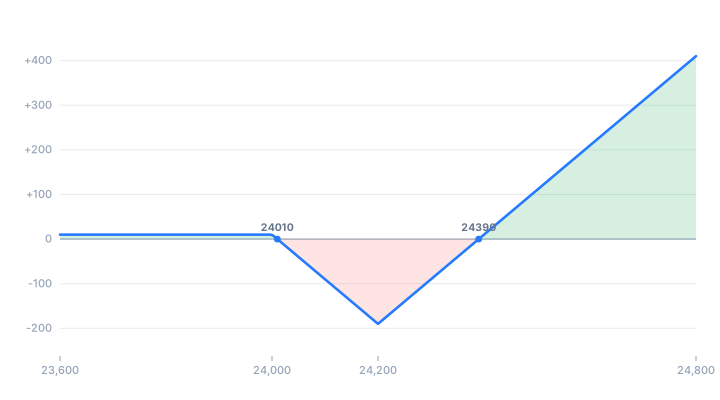
Read the net Greeks and the character is clear. Net positive delta, so it is bullish. Net long vega, because you hold two options and sold only one, so you want volatility to rise. Net negative theta, because owning more than you sold means time works against you while you wait for the break. This is a bullish, long-volatility, breakout trade, and crucially it is defined-risk: the most you can lose is that 190 points, a number you can write down, unlike a naked position.
The honest catch is written into the payoff. The single worst outcome is not a fall. It is a timid rise that stalls near 24,200 at expiry, the very "mildly bullish" result a beginner might expect. This trade wants a big move or nothing, and it punishes the middle.
The long call calendar
The second structure bets on time itself, and it is the one place in this course where the two legs have different expiries. A long calendar with calls sells a near-dated call and buys a call at the same strike in a later expiry.
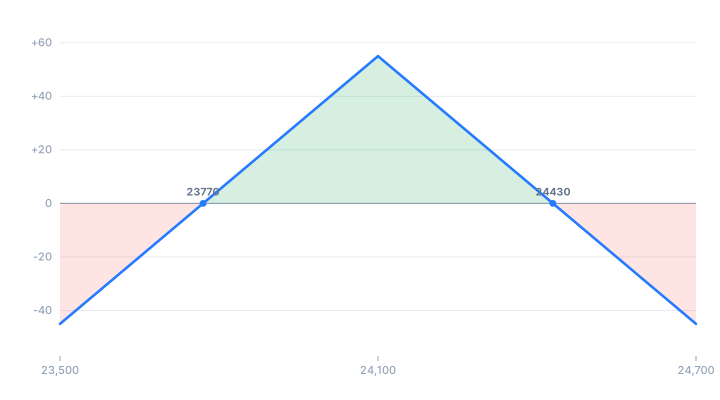
Suppose NIFTY is at 24,000 and you are mildly bullish but expect the next week to be quiet before any move. Sell this week's 24,100 call for 60, and buy next month's 24,100 call for 200. Your net debit is 140 points, 9,100 rupees, and that debit is your maximum loss. (Two-expiry figures are illustrative.)
Because the legs expire at different times, you cannot draw the payoff as one clean expiry line. Think of it in two acts instead. The near call you sold decays faster than the far call you own, because near-dated options lose time value more quickly. If NIFTY sits near 24,100 as the near expiry arrives, the call you sold expires worthless or nearly so, you keep its premium, and you are left holding a far-dated call bought at a discount. That is the good outcome, and it peaks when NIFTY finishes right at the strike at the near expiry. The payoff looks like a tent centred on 24,100.
What ruins it is a big move either way, or a fall in volatility. If NIFTY jumps far from 24,100, both calls move together and the gap between them, which is your profit, collapses back toward zero, so the most you lose is the 140-point debit. And because the far call holds most of the position's volatility exposure, a drop in implied volatility hurts you even if the price behaves.
The net Greeks are the signature to remember, because a calendar carries a rare pair of signs. Net positive theta, because the near call you sold decays faster than the far call you own, so time is your friend day to day. And net positive vega, because the far-dated call you own dominates the volatility exposure, so a rise in implied volatility helps you. Positive theta and positive vega at once is unusual, and it is exactly why traders reach for calendars: you are paid to wait and you profit if volatility picks up, as long as the price stays near your strike in the near term.
Two bets on more than direction
Set the two side by side and the grid's second axis is doing all the work. The call ratio back spread is bullish and wants a large, fast move, so it is long volatility and negative on time. The long call calendar is bullish and wants near-term calm then a drift, so it is positive on time and long on back-month volatility. Both would be described by a beginner as simply "bullish," and both would disappoint that beginner if the market merely edged up quietly, because neither was really a bet on direction alone.
Neither is a set-and-forget trade. The back spread needs the move to arrive before the long calls decay in the dead zone. The calendar needs watching around the near expiry, when you decide whether to close, roll the short call to a further date, or take the position off. These are tools for a trader who has a view on volatility, not just on price.
What to carry forward
Two bullish structures, both betting on volatility as much as direction. The call ratio back spread owns more calls than it sells, giving a small credit on a fall, a defined loss valley on a timid rise, and open-ended profit on a real breakout: bullish, long volatility, negative theta. The long call calendar sells near and buys far at one strike, profiting from faster near-term decay and rising back-month volatility while the price hovers near the strike: bullish, positive theta, positive vega. Both punish the lazy "it will drift up" view. The next chapter stays bullish but goes back to defined, cheap, and precise, betting that the rise lands in a specific zone, with the bull butterfly and the bull condor.