Course contents
The mirror of the bullish workhorses
A bear put spread and a bear call spread are the exact mirrors of the bullish vertical spreads. One is a debit built with puts, the other a credit built with calls, and both cap the loss that a single short leg would leave open.
- Build a bear put spread (a debit) and a bear call spread (a credit)
- Relate each to its bullish mirror from Part 2
- Compute max profit, max loss and breakeven
The last chapter left you with two flawed single legs: a long put that bleeds to time, and a naked short call whose loss has no floor. Adding a second leg fixes both, exactly as it did on the bullish side. What you get are the two bearish vertical spreads, and because you already learned the bull versions in full, this chapter is mostly a matter of holding the mirror up to them.
The bear put spread
The bear put spread is the mirror of the bull call spread. There you bought a call and sold a higher call; here you buy a put and sell a lower put, so the structure points down instead of up. Buy the NIFTY 24,000 put at 150, and sell the 23,800 put at 80. Your net outlay is a net debit of 70 points, 4,550 rupees for a lot. (All figures illustrative.)
Its card. The max loss is the net debit, 70 points, taken if NIFTY finishes above 24,000 and both puts expire worthless. The max profit is the width minus the debit, 200 minus 70, which is 130 points, taken below 23,800. The breakeven is the higher strike minus the debit, 23,930. The payoff is the bull call spread flipped left to right: flat on its loss floor above 24,000, rising as the market falls between the strikes, flat on its profit ceiling below 23,800.
It behaves just as its bullish twin did, reflected. Net negative delta, so it gains as NIFTY falls. Only a slight net theta, far gentler than the lone long put, because the put you sold decays in your favour. Near vega-neutral. It is a clean, moderately bearish bet with a small, known risk, and you reach for it when you expect an actual fall and want to pay for the move.
The bear call spread
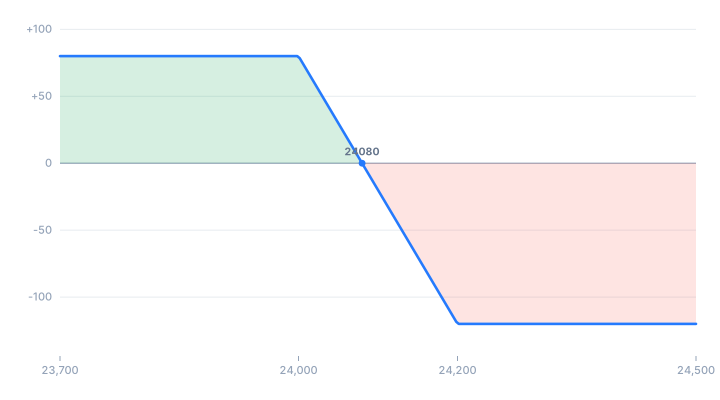
The bear call spread is the mirror of the bull put spread, and it is the more important of the two to understand, because it is the cure for the naked short call. Sell the NIFTY 24,000 call at 150, and buy the 24,200 call at 70. You receive 150 and pay 70, a net credit of 80 points, 5,200 rupees collected up front.
Look at what the bought 24,200 call did. On its own, the short 24,000 call had an unlimited loss. Buying the 24,200 call places a ceiling above it: no matter how far NIFTY rises, above 24,200 the call you own gains exactly as fast as the call you sold loses, so your loss stops. The terror of the naked call is gone, converted into a defined number.
Its card. The max profit is the credit, 80 points, kept whenever NIFTY finishes below 24,000. The max loss is the width minus the credit, 200 minus 80, which is 120 points, taken above 24,200, and that is now the worst that can happen, full stop. The breakeven is the lower strike plus the credit, 24,080. The payoff is a flat profit ceiling across everything below 24,000, sloping down to a flat, finite loss floor above 24,200.
Its Greeks are the bull put spread's, pointed down. Negative delta, positive theta, negative vega. Like all credit spreads, it does not need the market to move your way, only to not move hard against you: NIFTY can sit still or drift down and you keep the credit. It is the responsible way to express the bearish-income view that the naked short call expressed recklessly.
Choosing between them
The choice mirrors the bullish one exactly. Reach for the bear put spread, the debit, when you expect a genuine fall and want the position to gain as NIFTY drops toward your target; paying a debit is easier when implied volatility is low. Reach for the bear call spread, the credit, when you are bearish to neutral, expect the market to stall or drift, and would rather be paid to wait than pay for a move; collecting a credit is most attractive when implied volatility is high and the call you sell is rich.
Watch the two across the same NIFTY outcomes, the bear put spread (buy 24,000 put, sell 23,800 put) against the bear call spread (sell 24,000 call, buy 24,200 call).
| NIFTY at expiry | Bear put spread (P&L, points) | Bear call spread (P&L, points) |
|---|---|---|
| 23,500 (falls) | plus 130 | plus 80 |
| 23,930 (dips) | 0 | plus 80 |
| 24,000 (flat) | minus 70 | plus 80 |
| 24,080 (small rise) | minus 70 | 0 |
| 24,200 (rises) | minus 70 | minus 120 |
The call spread already wins on the flat day, where the put spread is still down its debit, because the credit spread does not need the fall. The put spread pulls ahead on a real drop to 23,500, where its 130 beats the capped 80. Each is best for the view it was built for, exactly as on the bullish side.
The same trap applies too. The bear call spread's wide, flat profit tempts oversizing, but the max loss of 120 is larger than the credit of 80, and a gap up delivers it at once. Size by the max loss, never the credit. This is education, not advice.
What to carry forward
The two bearish workhorses are simple reflections of the bullish ones. The bear put spread pays a debit and profits from a fall; the bear call spread collects a credit, profits from calm below your strike, and, most usefully, caps the naked short call's unlimited risk into a known loss. Choosing between them is again a choice about time and volatility, not direction. With the single legs and the verticals in hand for both directions, the next chapter clears the remaining bearish structures in one pass, because each is the mirror of a bullish one you have already met: the put ratio back spread, the long put calendar, the bear butterfly, and the bear condor.