Course contents
Jade lizard and reverse jade lizard
A jade lizard sells a put and a call spread so that, if the credit is large enough, there is no risk at all on the upside, leaving only the downside of the sold put. Its reverse flips this to remove the downside and leave the upside open.
- Build a jade lizard and check the no-upside-risk condition
- Build a reverse jade lizard and find which single side still carries risk
- Connect each to its neutral-to-bullish or neutral-to-bearish lean
The neutral part closes with two structures that do something clever: they remove the risk on one entire side of the trade by construction, not by buying expensive protection, but by arranging the legs so that the premium collected pays for one side completely. What is left is a premium-selling trade with risk on one side only, which lets you lean gently bullish or bearish while being paid to wait. The trick rests on a single condition you must check every time, and this chapter is really about that condition.
The jade lizard
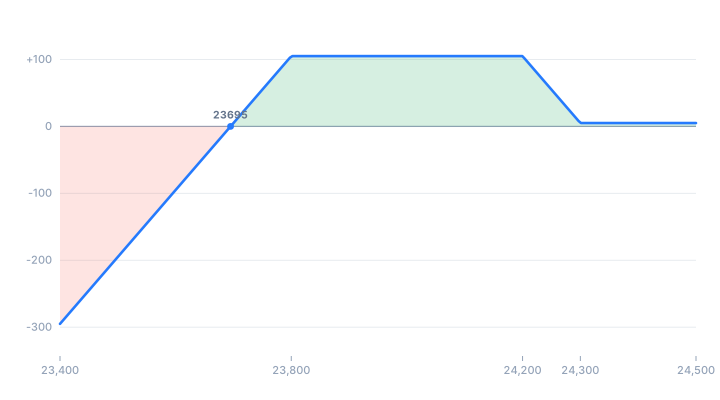
A jade lizard combines a naked short put with a short call spread. On NIFTY at 24,000, sell the 23,800 put at 80, sell the 24,200 call at 70, and buy the 24,300 call at 45. You collect 80 and 70 and pay 45, a net credit of 105 points. (All figures illustrative.) The short put leans you bullish, the call spread caps the upside, and the credit is the whole point.
Here is the clever part. The call spread can lose at most its width, which is 24,300 minus 24,200, or 100 points. You collected 105. Since the credit you took in (105) is larger than the most the call spread can cost you (100), there is no way for the upside to produce a loss. Even if NIFTY rockets past 24,300 and the call spread hits its full 100-point loss, you still keep 5 points. That is the signature of a jade lizard: when the net credit is at least the width of the call spread, the upside risk is gone entirely.
Trace it. Your max profit is the 105 credit, kept anywhere between 23,800 and 24,200. Above 24,300 the position settles at a small, guaranteed profit of 5, never a loss. All the risk sits on the downside: the naked short put. Your lower breakeven is the sold put strike minus the credit, 23,800 minus 105, which is 23,695, and below that your loss grows as NIFTY falls, exactly like the naked put it contains. So the jade lizard is neutral to moderately bullish: safe on the upside, exposed on the downside.
The reverse jade lizard
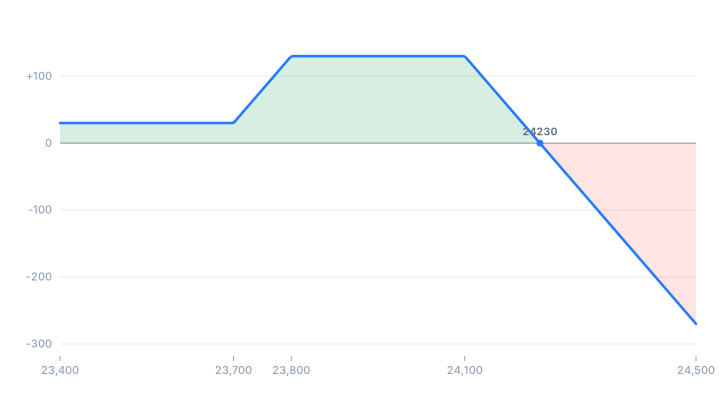
The reverse jade lizard mirrors it, removing the downside risk instead. Combine a naked short call with a short put spread. Sell the NIFTY 24,100 call at 105, sell the 23,800 put at 80, and buy the 23,700 put at 55. Your net credit is 130 points. The put spread's width is 23,800 minus 23,700, or 100, and again your credit of 130 is larger than that 100, so the downside is fully paid for. Below 23,700 the position holds a guaranteed profit of about 30 and never a loss.
Now the exposed side is the upside. Your max profit is the 130 credit, kept between 23,800 and 24,100. Your upper breakeven is the sold call strike plus the credit, 24,100 plus 130, which is 24,230, and above it your loss grows without limit, because the short call is naked. So the reverse jade lizard is neutral to moderately bearish: safe on the downside, exposed on the upside, and carrying the naked short call's unlimited risk you were warned about in Part 3.
Do not let the safe side lull you
These are elegant, and the elegance is exactly the trap. "No risk on the upside" is a true and pleasant sentence, but the sentence that matters is the other one: the downside is a naked put that can lose far more than you collected. A jade lizard is, underneath, a bull-leaning short put with a free call spread attached, and a market crash hurts it just as badly as it hurts any naked put seller. The reverse is worse in one respect, because its exposed side is a naked call, whose loss is not merely large but unlimited. The protected side is genuinely protected. The other side is genuinely dangerous. Both need margin, and both need you to size by the risky side, never comforted by the safe one.
What to carry forward
The jade lizard and its reverse remove the risk on one full side by arranging for the credit to cover a spread on that side. In a jade lizard, credit at least as large as the call-spread width means no upside risk, leaving a bullish-leaning naked put below. In the reverse, credit at least as large as the put-spread width means no downside risk, leaving a bearish-leaning naked call above. Check that credit-versus-width condition every time, and never forget which side is still naked. That closes the neutral strategies. Part 5 turns everything upside down: the big-move strategies, where instead of selling calm you pay for a storm, and where the loud warnings finally ease, because you are the buyer again.