Course contents
The bullish workhorses
A vertical spread pairs a bought and a sold option at two strikes to make a cheaper, capped bullish bet. You can build it for a debit with calls or for a credit with puts, and both express the same view.
- Build a bull call spread (a debit) and a bull put spread (a credit)
- Compute the max profit, max loss and breakeven of each
- Choose between paying a debit and collecting a credit for the same view
The two single legs each had an uncomfortable side. The long call bleeds to time. The short put carries an open-ended loss. Add one more leg to either and both problems shrink at once. What you get is a vertical spread, two options of the same type and expiry at two different strikes, one bought and one sold. Vertical spreads are the workhorses of directional trading, the structures you will reach for most often, so this chapter takes both bullish versions apart in full.
You have in fact already met one. The running example from Part 1 was a bull call spread. Now meet it as a strategy in its own right, alongside its twin.
The bull call spread
The bull call spread cures the long call's cost and decay by selling a higher call against it. Buy the NIFTY 24,000 call at 150, and sell the 24,200 call at 70. Your net outlay is 150 minus 70, a net debit of 80 points, or 5,200 rupees for a lot of 65. (All figures illustrative.)
Its card, worked in Part 1 and repeated here so it sits beside its twin. The max loss is the net debit, 80 points, taken if NIFTY finishes below 24,000 and both calls expire worthless. The max profit is the width minus the debit, so 200 minus 80, which is 120 points, taken above 24,200 where the spread is worth its full width. The breakeven is the lower strike plus the debit, 24,080. The payoff is flat on its floor below 24,000, rising between the strikes, and flat on its ceiling above 24,200.
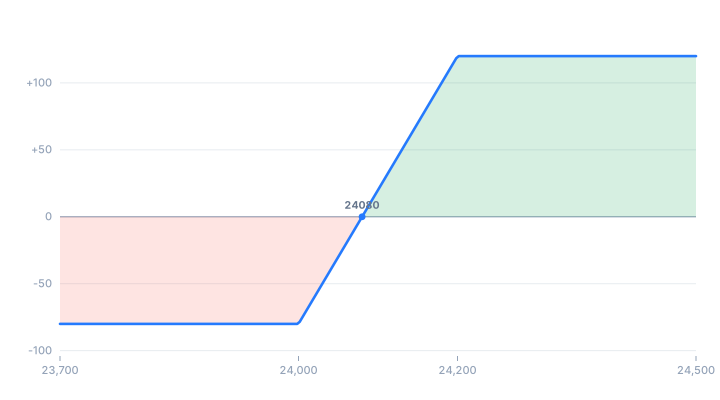
Against the plain long call, you gave up the open-ended upside above 24,200. In return you cut the cost from 3,750 to 2,000, dropped the breakeven from 24,150 to 24,080, and softened the daily bleed, because the call you sold decays in your favour and offsets most of the decay on the call you own. Its net delta is positive but modest, its net theta is only slightly negative, and its net vega is near zero. This is a clean, moderately bullish bet with a known, small risk.
The bull put spread
Now the twin that expresses the same bullishness for a credit. The bull put spread is built from puts: sell the higher-strike put and buy the lower-strike one. Sell the NIFTY 24,000 put at 150, and buy the 23,800 put at 80. You receive 150 and pay 80, a net credit of 70 points, 4,550 rupees, collected the moment you enter.
Its card is the credit-spread mirror. The max profit is the credit, 70 points, kept whenever NIFTY finishes above 24,000 and both puts expire worthless. The max loss is the width minus the credit, 200 minus 70, which is 130 points, taken below 23,800. The breakeven is the higher strike minus the credit, 23,930. The payoff is a flat profit ceiling across everything above 24,000, sloping down to a flat loss floor below 23,800.
Notice what this structure asks of the market. It does not need NIFTY to rise at all. It only needs NIFTY to stay above 23,930. A flat market, even a slightly falling one, still pays you the full credit. Its Greeks say the same thing: positive delta, but also positive theta, so time works for you, and negative vega, so you are a net seller of volatility. Where the call spread leans long volatility and needs a move, the put spread leans short volatility and is paid to wait.
Choosing between them
Both spreads are bullish, both are defined-risk, both tie up only a small margin close to their capped loss. So which do you use? The honest answer is that they suit slightly different views and different volatility conditions, and reading which is which is exactly the skill Part 1 built.
Reach for the bull call spread when you expect an actual push upward and want the position to gain as NIFTY climbs toward your target. Paying a debit is easier to stomach when implied volatility is low, because the options you buy are not overpriced. Its profit comes from the move.
Reach for the bull put spread when you are bullish to neutral, expect calm or a slow grind, and would rather be paid to wait than pay for a move. Collecting a credit is most attractive when implied volatility is high, because the put you sell is rich, and you keep more of it as volatility falls back. Its profit comes from time and from nothing bad happening.
Watch the two across the same NIFTY outcomes, the call spread (buy 24,000 call, sell 24,200 call) against the put spread (sell 24,000 put, buy 23,800 put).
| NIFTY at expiry | Bull call spread (P&L, points) | Bull put spread (P&L, points) |
|---|---|---|
| 23,700 (falls) | minus 80 | minus 130 |
| 23,930 (dips) | minus 80 | 0 |
| 24,000 (flat) | minus 80 | plus 70 |
| 24,080 (small rise) | 0 | plus 70 |
| 24,200 (rise) | plus 120 | plus 70 |
The put spread already wins on the flat day, where the call spread is still down its debit, because the put spread does not need the rise. But the call spread pulls ahead on a genuine move to 24,200, where its 120 beats the put spread's capped 70. Each is best for the view it was built for.
The trap in the flat payoff
The bull put spread's wide, flat profit tempts a specific mistake. Because it wins across such a broad range, it feels almost certain, and people size it too large, thinking of the 70-point credit as the trade. The trade is the 130-point loss. Here the most you can lose is nearly double the most you can make, and a gap down through 23,800 pays that loss in full and at once. Always size a credit spread by its max loss, never by the credit, and remember the max loss can arrive overnight on a gap the payoff diagram makes look gradual.
What to carry forward
The vertical spread is the workhorse: two strikes, one bought and one sold, giving a cheaper, capped, defined-risk directional bet. The bull call spread pays a debit and profits from a rise; the bull put spread collects a credit and profits from calm above your strike. They are the same view in two moods, and choosing between them is really a choice about time and volatility, not direction. In Part 3 you will meet their exact reflections, the bear put spread and the bear call spread. Next, though, two structures that keep the bullish view but add a real bet on volatility itself: the call ratio back spread and the long call calendar.