Course contents
Two ways to be bearish, one of them dangerous
You can be bearish by buying a put, with loss capped at the premium, or by selling a call. A naked short call is the single most dangerous leg in options, because a rising market has no ceiling.
- Contrast buying a put with selling a naked call on risk, reward and margin
- Explain why a naked short call carries unlimited loss and demands heavy margin
- State each one's max profit, max loss and breakeven
Part 3 turns the whole toolkit downward. The good news is that every bearish structure is the mirror of a bullish one you already understand, so this part moves quickly. The warning is that the mirror world contains the most dangerous single trade in all of options, and this first chapter is where you meet it. Being bearish, done carelessly, can hurt you in a way being bullish never can.
Just as bullishness had two roots, a long call and a short put, bearishness has two: a long put and a short call. But the symmetry is not clean, and the reason it is not clean is the whole point of this chapter.
Buying a put
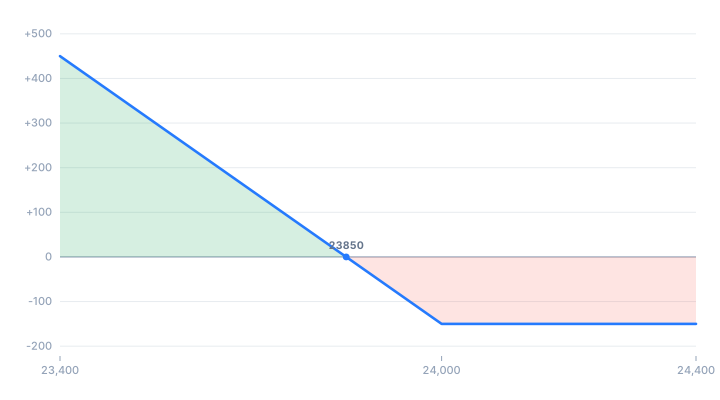
A long put is the right to sell the underlying at a fixed strike, bought for a premium. It is the exact mirror of the long call. Buy the NIFTY 24,000 put at 150 points, 9,750 rupees for a lot of 65. (All figures illustrative.)
Its card mirrors the call's. Your max loss is the premium, 150 points, however far NIFTY rises. Your max profit is large, growing point for point as NIFTY falls below the strike, all the way down, so treat it as open-ended even though it stops at NIFTY reaching zero. Your breakeven is the strike minus the premium, 23,850, the level NIFTY must fall below before you are ahead. The payoff is a hockey stick pointing the other way: flat along the bottom above the strike, bending up into profit as the market drops.
Its Greeks are the long call's reflected. Negative delta, so it profits when NIFTY falls. Negative theta, so time works against you, the same quiet daily bleed. Positive vega, so it likes rising volatility. And like the long call, it has the buyer's honest weakness: a slow or late fall can still lose you the premium even though your direction was right. The long put is also the market's basic insurance, the way you protect a portfolio you own, which you met in Options Basics as the protective put.
Selling a call, and why it is different
Now the leg that breaks the symmetry. A short call, selling a call you do not cover, obligates you to deliver the underlying at the strike if it rises there. Sell the NIFTY 24,000 call at 150 and you collect 9,750 rupees up front, exactly as selling the put did on the bullish side. The difference is what happens when you are wrong.
When you sold a put, your loss was large but bounded, because the underlying can only fall to zero. When you sell a call, your loss is not bounded at all, because the underlying can rise without any ceiling. Your max profit is the premium, 150 points, kept if NIFTY finishes below 24,000. Your max loss is unlimited, growing without limit as NIFTY climbs. Your breakeven is the strike plus the premium, 24,150. The payoff is a flat profit ceiling below the strike that then falls away, and keeps falling, with no floor beneath it.
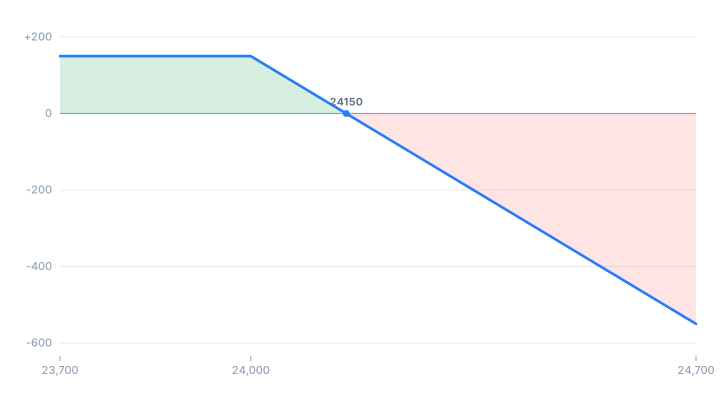
This is the single most dangerous position a beginner can take. A naked short call looks like calm income in a quiet market, right up until a gap. Imagine you sold that 24,000 call for 150 and overnight news sends NIFTY to 24,800. The call is now worth 800, you are down 650 points on a position that could only ever have made you 150, and if the move continues you keep losing. There is no natural stopping point. This is why the exchange demands heavy margin to sell a call, the SPAN plus exposure of Part 1, and why that margin can be called in fast when the position moves against you.
The responsible cousin is the covered call, where you already own the underlying, so a rise that costs the short call is paid for by the stock you hold going up. Covered, the risk is defined and the trade becomes a way to earn income on a holding, which you met in Options Basics. Naked, the same short call is a different and far more dangerous animal.
The asymmetry, side by side
Watch the two bearish legs across a few NIFTY outcomes, buying the 24,000 put at 150 against selling the 24,000 call at 150.
| NIFTY at expiry | Long 24,000 put (P&L, points) | Naked short 24,000 call (P&L, points) |
|---|---|---|
| 23,000 (falls) | plus 850 | plus 150 |
| 23,850 (small fall) | 0 | plus 150 |
| 24,000 (flat) | minus 150 | plus 150 |
| 24,150 (small rise) | minus 150 | 0 |
| 25,000 (jumps) | minus 150 (capped) | minus 850 and rising |
Both make money when NIFTY falls, as bearish trades should. But look at the top and bottom rows. When the market crashes your way, the put buyer's gain grows while the call seller's is stuck at 150. And when the market jumps against you, the put buyer's loss is capped at 150 while the call seller's loss runs to 850 and keeps going. The put buyer has paid for safety. The naked call seller has sold it, and can be ruined by the very outcome they were betting against.
What to carry forward
The two roots of bearishness are the long put, the mirror of the long call, with a capped premium loss and a large, time-pressured gain, and the short call, which collects a premium but, left naked, carries a truly unlimited loss because the market can rise forever. This broken symmetry is why bearish trading demands more respect than bullish. The fix is the same as it was on the bullish side: add a second leg to cap the risk. The next chapter does exactly that, giving you the bear put spread and the bear call spread, the mirrors of the bull spreads, with the bear call spread turning that dangerous naked call into a defined-risk trade.