Course contents
Two ways to be bullish
You can be bullish by buying a call, where you pay a premium and time works against you, or by selling a put, where you collect a premium and time works for you but you may be forced to buy. Same direction, opposite trades.
- Contrast buying a call with selling a put on cost, time decay, and what can go wrong
- State each one's max profit, max loss and breakeven
- Say when a mildly bullish view favours selling a put over buying a call
Remember the two traders from the grid chapter, both bullish on NIFTY, one buying a call and one selling a put, ending two weeks later with opposite results. Now that you have the toolkit, we can take those two trades apart properly, because they are the two roots of every bullish structure in this course. Everything else in Part 2 grows from cheapening the call or capping the put.
You met both moves in Options Basics. Here you meet them as strategies: their full cards, side by side, and the rule for choosing between them.
Buying a call
A long call is the right to buy the underlying at a fixed strike, bought for a premium. Take the NIFTY 24,000 call at 150 points, which at a lot size of 65 costs 9,750 rupees for one lot. (Lot size and all figures here are illustrative; confirm the current NIFTY lot size.)
Its card is short. Your max loss is the premium, 150 points or 9,750 rupees, and not a paisa more, however far NIFTY falls. Your max profit is unlimited, rising point for point with NIFTY above the strike. Your breakeven is the strike plus the premium, 24,150, the level NIFTY must clear before you are ahead. The payoff is the familiar hockey stick: flat along the bottom until the strike, then bending up into open-ended profit.
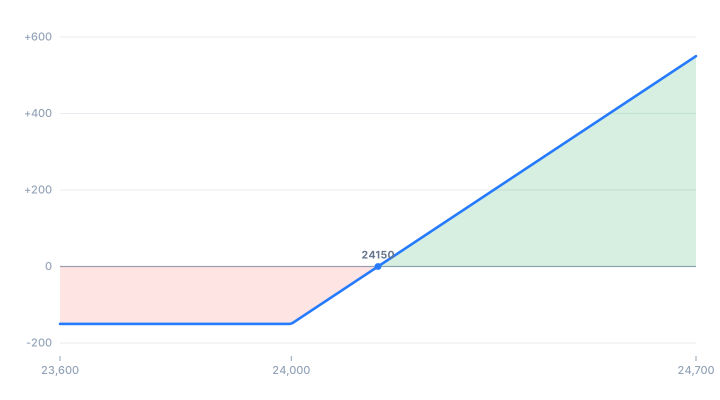
Read its Greeks from Part 1 and you know its character. Positive delta, so it climbs when NIFTY climbs. Negative theta, so it bleeds a little every day. Positive vega, so it likes rising volatility. That negative theta is the whole problem with a long call. Time is against you, working quietly every single day, so being bullish is not enough. You need NIFTY to rise far enough to clear 24,150, and soon enough to beat the decay. A slow drift up to 24,100 still loses you money, even though you were right about the direction.
Selling a put
A short put, or selling a put, is the opposite side of the same instrument. You sell someone the right to sell NIFTY to you at the strike, and they pay you the premium. Take the NIFTY 24,000 put, also at 150 points. You collect 9,750 rupees up front, and that is the day's high point for your account.
Its card is the mirror of the call's. Your max profit is the premium, 150 points, kept in full as long as NIFTY finishes above the strike so the put expires worthless. Your max loss is large: as NIFTY falls below the strike, the put you sold grows in value against you, and your loss grows with it, all the way down. It is not literally unlimited, because NIFTY cannot fall below zero, but at a strike of 24,000 the possible loss is so large that you should treat it as open-ended. Your breakeven is the strike minus the premium, 23,850, below which you start losing real money. The payoff is a flat ceiling at your premium, holding across every price above the strike, then falling away below breakeven.
Its Greeks are the call's turned around. Positive delta, so it too profits when NIFTY rises. But positive theta, so time is now your friend: every day that passes, the put you sold is worth a little less, and that decay is money in your pocket. And negative vega, so you are hurt by rising volatility and helped by falling volatility. This is the seller's world you met in Options Basics: paid up front, time on your side, in exchange for a small capped gain and a large open risk.
The same direction, opposite trades
Put the two cards together and the grid chapter comes to life. Both are bullish, both have positive delta. But the call buyer pays, wants a real move, and loses to time, while the put seller collects, is happy with calm, and gains from time. One is leaning long volatility, the other short it. That is why the same "I am bullish" produced opposite results for the two traders.
Watch them race across a few expiry outcomes for NIFTY, buying the 24,000 call at 150 against selling the 24,000 put at 150.
| NIFTY at expiry | Long 24,000 call (P&L, points) | Short 24,000 put (P&L, points) |
|---|---|---|
| 23,500 (falls) | minus 150 (capped) | minus 350 |
| 24,000 (flat) | minus 150 | plus 150 |
| 24,150 (small rise) | 0 | plus 150 |
| 24,300 (rise) | plus 150 | plus 150 |
| 25,000 (jumps) | plus 850 | plus 150 |
The seller wins on the flat and the small-rise days, exactly where the buyer bleeds, because a quiet market is worth money to the seller and nothing to the buyer. The buyer wins only when NIFTY jumps, where the seller's gain is stuck at the premium. And on the fall, the buyer's loss is capped at 150 while the seller's runs to 350 and would keep going. Same view, opposite risk.
The cash-secured put, and the danger
Selling puts has a respectable use that is worth naming, because it is where the strategy makes sense for a patient investor. If there is a stock you would happily own at a lower price, you can sell a put at that price and get paid to wait. If it stays up, you keep the premium. If it falls to the strike, you are assigned: obligated to buy the stock at the strike, which you wanted anyway, now cushioned by the premium you collected. Doing this with the cash already set aside to buy the shares is called a cash-secured put. Take Infosys near 1,500 rupees (illustrative). If you would gladly buy it at 1,450, selling the 1,450 put pays you now, and either you keep that payment or you buy the stock you wanted at an effective price below 1,450.
The danger is doing this without the cash, and without the willingness. Naked put selling looks like easy income in a calm market, right up until a sharp fall, when a single bad week can erase months of collected premiums and hand you a stock, or a cash loss, far larger than anything you took in. Remember too that the position ties up margin the whole time, as Part 1 explained, and that an index put settles in cash while a stock put delivers you the actual shares.
What to carry forward
The two roots of bullishness are the long call, which pays a premium for a capped loss and open-ended, time-pressured upside, and the short put, which collects a premium for a capped gain and a large, patient, time-friendly risk. Choose the call when you expect a real, timely move and want limited risk; lean toward selling a put when you are mildly bullish or neutral, expect calm, and are willing and funded to own the underlying. Both single legs have an uncomfortable side: the call's decay, the put's open risk. The next chapter fixes both at once by adding a second leg, giving you the bull call spread and the bull put spread, the two workhorses of bullish trading.