Course contents
Iron butterfly and short iron condor
Buy a cheap wing on each side of a short straddle or strangle and the uncapped loss becomes a known, capped one. An iron butterfly and a short iron condor are the defined-risk way to sell a range.
- Turn a short straddle into an iron butterfly and a short strangle into a short iron condor by adding wings
- Compute the defined max loss and the reduced margin
- Explain why "short" here means short volatility
The short straddle and strangle had one flaw, and it was a serious one: an unlimited loss. This chapter fixes it with a single, cheap addition. Buy one far option on each side, and the bottomless loss becomes a small number you choose in advance. What you get are the two structures most traders actually use to sell a range, because they keep the income and the positive time decay while removing the part that can end an account.
The iron butterfly
Take the short straddle from the last chapter, selling the NIFTY 24,000 call and put for 300, and add two wings: buy the 23,800 put for 80 and the 24,200 call for 70, at a cost of 150. You have built an iron butterfly, a short straddle wrapped in protection. Your net credit is now 300 minus 150, a net credit of 150 points, 9,750 rupees. (All figures illustrative.)
The wings change the ending completely. Your max profit is the net credit, 150, still reached at 24,000 where everything but your kept premium expires worthless. But now your max loss is capped: it is the width from the sold strike to a wing, minus the credit, so 200 minus 150, which is just 50 points, 3,250 rupees, and it cannot get worse no matter how far NIFTY runs. The far options you bought take over beyond the wings and march in step with your losing short, freezing the damage. Your breakevens are 23,850 and 24,150, a little narrower than the naked straddle's, because you spent part of the premium on safety.
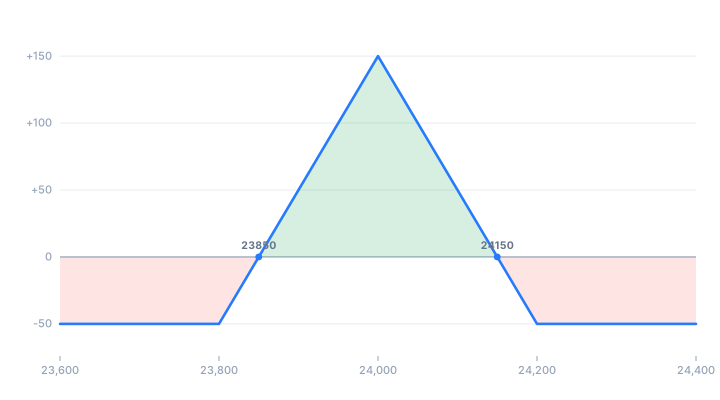
Look at the trade you made. You cut your maximum profit in half, from 300 to 150, and in return you converted an unlimited loss into a fixed 50, and you slashed the margin, because the exchange now sees a capped risk instead of an open one. For most traders that is a trade well worth making.
The short iron condor
Do the same to the short strangle and you get a short iron condor. Start from selling the 24,200 call at 70 and the 23,800 put at 80, a credit of 150, then buy the 24,400 call at 28 and the 23,600 put at 38, spending 66. Your net credit is 84 points, 5,460 rupees. Your max profit is that 84, kept across the whole band from 23,800 to 24,200. Your max loss is the wing width minus the credit, 200 minus 84, which is 116 points, beyond either wing. Your breakevens are 23,716 and 24,284. The payoff is a flat profit plateau across the middle, dropping to a capped loss on each side.
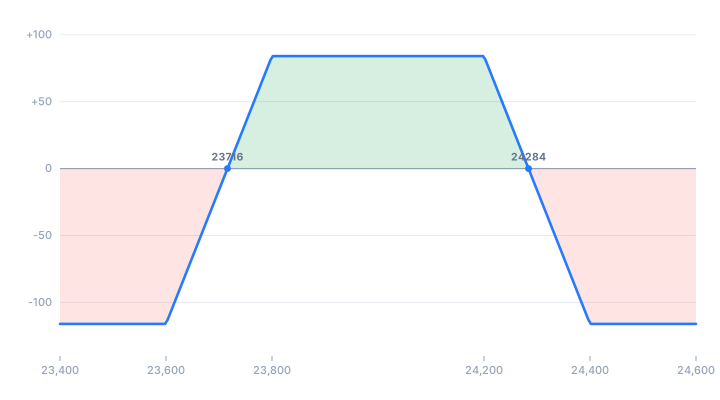
The choice between the two mirrors the straddle-versus-strangle choice, now with defined risk on both. The iron butterfly peaks higher (150) but only near a single price. The iron condor pays less (84) but across a wide band, so it is right more often. Both live on positive theta and negative vega: you are paid by time and by falling volatility, and hurt by a rise in either the price range or the volatility.
Why "short", and the honest limit
The app calls these the short iron condor and the iron butterfly, and the word "short" is worth decoding, because Part 5 will show you "long" versions that look almost identical. Here "short" means short volatility. You are a net seller of options, you collect a credit, and you want the market quiet and volatility falling. The long versions in Part 5 flip that: they pay a debit and want a big move. Reading which one you are holding, short volatility or long, is the same net-vega skill from Part 1.
Defined risk is safer than naked selling, but it is not safe. Notice the short iron condor risks 116 to make 84: the capped loss is larger than the credit, which is normal for range selling, and it means a single month where the market trends out of your band can erase more than a month of quiet wins. The temptation is to sell a very wide condor with a tiny credit that "almost always" pays, and then to be wrecked by the rare breakout that pays the full, larger loss. Choose strikes by a realistic sense of the range, not by the fattest premium, and size by the capped loss.
What to carry forward
Adding a bought wing on each side turns the dangerous straddle and strangle into the defined-risk iron butterfly and short iron condor. You surrender part of the premium and gain a capped, known loss and a much smaller margin. The iron butterfly peaks at one strike for a higher credit; the short iron condor pays a flat plateau across a band for a wider margin of safety. Both are short-volatility, positive-theta trades, and both still lose, in a bounded way, if the market leaves their range. The next chapter takes range selling one step stranger, into two structures whose payoff has two humps rather than one: the Batman and the Double Plateau, which look alike and carry opposite risks.