Course contents
Where the numbers come from
The payoff picture is not magic. For any multi-leg position you can work out the net premium, the breakevens, and the maximum profit and loss by hand, and you should, so the builder never surprises you.
- Compute net premium, max profit, max loss, and breakeven for a two-leg spread with real figures
- Separate defined-risk structures from undefined-risk ones
- Check the builder's numbers against your own arithmetic
The strategy builder tells you our NIFTY spread can make at most 120 points, lose at most 80, and breaks even at 24,080. Those are three numbers on a screen. Before you put money behind them, you should be able to produce all three yourself with nothing but arithmetic. Not because the builder is wrong, but because a trader who cannot check the machine cannot catch a fat-fingered strike, and cannot tell a good spread from a bad one when the builder is not open.
The good news: for a two-leg spread, the whole calculation is four short steps.
Step one, the net premium
You have two legs. One you bought and paid for, one you sold and were paid for. The net premium is simply the difference.
For our bull call spread, you bought the 24,000 call for 150 and sold the 24,200 call for 70. You paid 150 and received 70, so on balance you paid 80. That 80 is a net debit, money out of your pocket. If the leg you sold had been worth more than the leg you bought, the difference would have come into your pocket instead, and that would be a net credit. Debit means you paid to enter; credit means you were paid to enter. Everything else follows from which one you have.
Step two, the width
The two strikes are 24,000 and 24,200, so the gap between them is 200 points. Call this the width of the spread. The width is the total size of the pie that the two traders in this spread are dividing between them. Hold that thought, because it gives you a check at the end.
Step three, max profit and max loss
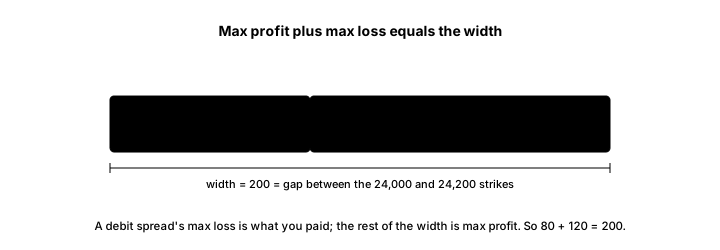
For a debit spread like this one, you paid to get in, so the most you can lose is exactly what you paid. Your max loss is the net debit, 80 points. It happens when both calls expire worthless, which is any finish below 24,000.
Your max profit is the width minus the net debit: 200 minus 80, which is 120 points. It happens when the spread is worth its full width, which is any finish above 24,200, where both calls are in the money and the gap between them is locked at 200.
Now the check. Notice that max profit plus max loss is 120 plus 80, which equals 200, the width. That is not a coincidence. In any vertical spread, the two outcomes always add up to the width, because the width is the whole pie and the debit decides how it is split. If your max profit and max loss do not add up to the gap between the strikes, you have made an arithmetic error. (In the real world they add up to slightly less than the width, once costs take their bite, which the real-world chapter covers.)
Turn the points into rupees with the lot size. One NIFTY lot is 65 units in this example, so one point is 65 rupees. Your max loss is 80 times 65, which is 5,200 rupees. Your max profit is 120 times 65, which is 7,800 rupees. You are risking 5,200 rupees to make up to 7,800, a reward of one and a half times your risk, if NIFTY finishes above 24,200. (Lot size is illustrative; confirm the current NIFTY lot size.)
Step four, the breakeven
For a debit call spread, you climb out of your loss as the bought call gains, so you break even once the underlying has risen by the amount you paid. Breakeven is the lower strike plus the net debit: 24,000 plus 80, which is 24,080. Below it you lose, above it you gain, up to the ceiling.
The same view as a credit
The same four steps read a credit spread, and it is worth doing once so the mirror is clear. Suppose you wanted that bullish view but preferred to collect premium rather than pay it. You sell the 24,000 put for 150 and buy the 23,800 put for 80. This is a bull put spread.
Net premium: you received 150 and paid 80, so you collect 70 points. That is a net credit. Width: 24,000 minus 23,800 is 200. For a credit spread, the most you can make is the credit you took in, so max profit is 70 points, kept whenever NIFTY finishes above 24,000 and both puts expire worthless. The most you can lose is the width minus the credit, so max loss is 200 minus 70, which is 130 points, at any finish below 23,800. Check: 70 plus 130 is 200, the width. Breakeven is the higher strike minus the credit, 24,000 minus 70, which is 23,930.
So two different structures, a debit call spread and a credit put spread, both express the same mild bullishness on NIFTY, with slightly different numbers and different cash flows at entry. Which to prefer is a real decision, and the bullish chapters return to it. The point here is that the same four steps decode both.
Defined risk and undefined risk
Look again at every number you just produced. Max loss 80 points. Max loss 130 points. Each is a finite figure you wrote down before entering. That property has a name: defined risk. In a defined-risk trade you know your worst case in advance, and nothing the market does can make it worse.
Now recall the naked sold option from Options Basics. Sell a call and leave it uncovered, and there is no width to cap it, because there is no second leg. As the underlying rises, your loss grows and grows, and you cannot write down a maximum, because there is not one. That is undefined risk, and it is a different animal entirely. The whole reason a spread adds a second leg is often precisely to convert an undefined risk into a defined one, trading away some profit for a worst case you can name.
What to carry forward
Four steps decode any vertical spread: find the net premium (debit or credit), find the width, then max profit and max loss (which always add up to the width), then the breakeven. Convert points to rupees with the lot size so you see the real money. Most of all, hold the line between defined risk, a worst case you can name, and undefined risk, a loss with no floor. You now have the numbers. The next chapter explains why a position that will end at these numbers can look very different on any given day before expiry, because between now and then, the Greeks are in charge.