Course contents
Betting the rise lands in a zone
A bull butterfly and a bull condor are cheap, defined-risk bets that the underlying rises to a specific zone by expiry and stops there. You pay little, and you win only if the move lands where you called it.
- Build a bull butterfly (a single profit peak) and a bull condor (a profit band)
- State their small cost and their defined max loss
- Weigh the low cost against the low chance of landing in the zone
So far your bullish views have been open-ended: up, and the more the better. But sometimes you have a sharper opinion. You think NIFTY, at 24,000, drifts up to about 24,300 over the next couple of weeks and then stalls, because that is where a resistance level sits, or where the next event caps it. Betting "up, to about here, and no further" needs a different kind of structure, one that pays most when the market finishes in a chosen zone and pays nothing if it overshoots.
The bull butterfly and the bull condor do exactly this. They are cheap, they are defined-risk, and they are the first strategies you have met whose whole appeal is precision rather than participation.
The bull butterfly
A bull butterfly is a three-strike structure, built here from calls, all above the current price: buy one call at a lower strike, sell two calls at a middle strike, and buy one call at a higher strike, with the strikes equally spaced. The two you sell sit at your target price. The two you buy, one below and one above, cap the risk on each side.
Buy the NIFTY 24,100 call at 105, sell two 24,300 calls at 45 each, and buy the 24,500 call at 18. The cash works out to 105 paid, 90 received, 18 paid, a net debit of 33 points, just 2,145 rupees for a lot. (All figures illustrative.) That tiny cost is the whole point: you are risking very little.
Its card. The max loss is the net debit, 33 points, taken if NIFTY finishes below 24,100 or above 24,500, where the structure is worth nothing. The max profit is the distance between adjacent strikes minus the debit, 200 minus 33, which is 167 points, or 10,855 rupees, and it is reached at exactly 24,300, your target, where the calls you sold expire worthless and the low call you own is worth its full 200. The two breakevens are 24,133 on the way up and 24,467 coming down. Between them you profit, peaking sharply at 24,300. The payoff is a tent: nothing on either side, rising to a single peak at the middle strike.
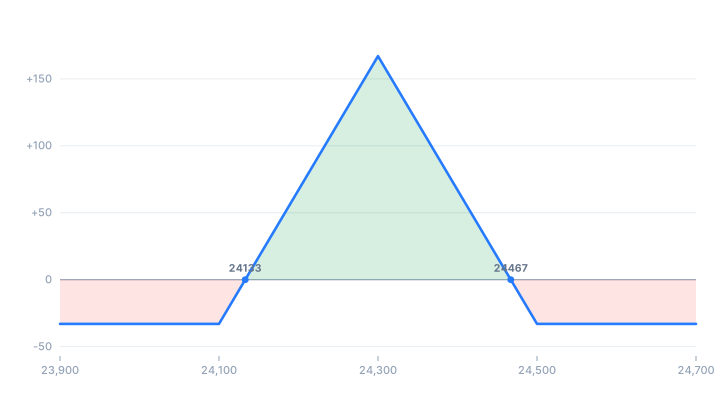
Look at the reward against the risk: 167 points of profit for 33 at stake, about five to one. That ratio is what draws people to butterflies. It is also exactly where the honesty has to come in.
Read its Greeks and you see it is really a volatility trade in disguise. Near the target it is roughly delta-neutral, but it is short vega: it wants the price to settle and volatility to fall so the sold middle calls decay. It is bullish only because the whole tent is pitched above the current price. A butterfly is a bet on where, not just which way.
The bull condor
A bull condor is a butterfly with its single peak pulled apart into a plateau. Instead of selling two calls at one middle strike, you sell two calls at two different middle strikes, so the profit sits flat across a band rather than at a point. It is the structure to use when your target is a zone, not a price.
Buy the NIFTY 24,100 call at 105, sell the 24,300 call at 45, sell the 24,500 call at 18, and buy the 24,700 call at 8. The cash is 105 paid, 45 received, 18 received, 8 paid, a net debit of 50 points, 3,250 rupees. A little dearer than the butterfly, because the profit zone is wider.
Its card. The max loss is the net debit, 50 points, below 24,100 or above 24,700. The max profit is the lower gap minus the debit, 200 minus 50, which is 150 points, and here it holds flat across the whole band from 24,300 to 24,500, not at a single price. The breakevens are 24,150 and 24,650. The payoff is a trapezoid: a flat floor of small loss on each side, ramps up on the inside, and a flat profit plateau across the middle.
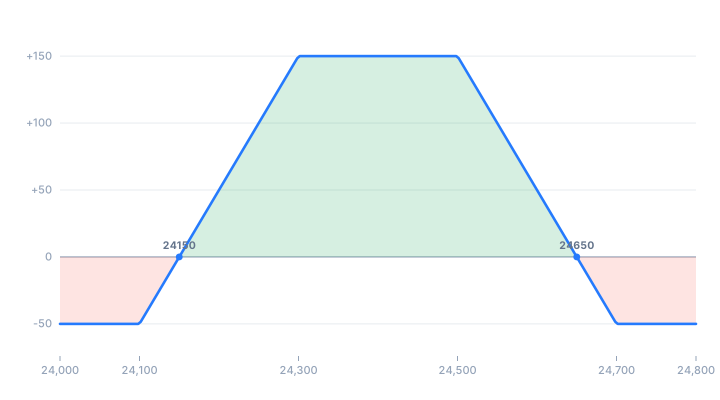
The trade against the butterfly is plain. The condor gives you a wider zone to be right in, so a higher chance of landing in profit, but it costs more and its peak reward is lower, 150 against 167. The butterfly is the sniper's bet on a single price; the condor is the wider net across a band. Both are cheap, both are defined-risk, and both are short volatility, wanting the market to settle into their zone.
Cheap is not the same as good
These structures are seductive because the numbers look wonderful and the cost is trivial. Hold two cautions firmly. First, the low cost buys a low probability, and over many trades the small losses add up while the rare big win has to carry them; the pleasing ratio does not mean a pleasing outcome. Second, both are four-leg trades, and Part 1's warning about costs bites hardest here: four legs mean four sets of brokerage, taxes, and bid-ask spread on the way in and again on the way out, and on a structure whose whole edge is a 33-point debit, those frictions can swallow a real slice of the profit. A butterfly that looks like it makes 167 might net noticeably less after the market takes its cut.
What to carry forward
The bull butterfly and bull condor let you bet not just that NIFTY rises but that it rises to a particular place and stops. Buy the wings, sell the middle, pitch the whole thing above the current price. The butterfly peaks at one strike for a higher reward and lower chance; the condor pays a flat plateau across a band for a lower reward and higher chance. Both are cheap, defined-risk, and short volatility, and both charge you a real cost in probability and in four-leg frictions for that low price. You have now seen bullishness expressed by buying, by selling, by spreads, by volatility bets, and by targeted zones. The last bullish chapter shows how to be long without buying a plain call at all, using futures and synthetics, and the parity idea that ties calls, puts, and futures together.