Course contents
When a loss makes you dangerous
After a painful loss comes the urge to win it straight back with a bigger, hastier trade. This is tilt, and revenge trading is how a manageable loss becomes an account-ending one, especially with leverage.
- Describe tilt and revenge trading and how they spiral
- Connect them to sunk-cost thinking and averaging into losers
- Give the practical break, a loss limit and stepping away
A trade hits its stop and you take a clean, planned loss, exactly the 2,000 rupees you decided to risk. That is not the dangerous moment. The dangerous moment is the next one, when instead of feeling nothing much you feel a hot flush of anger and a single thought forms: I need to make that back, now. That state has a name borrowed from poker, tilt, and the trading it produces has ended more accounts than any crash, because it takes a person who was following good rules and turns them into someone who cannot see the rules at all.
Tilt: when emotion takes the wheel
Tilt is the state of emotional overwhelm, usually after a loss, in which you stop trading your plan and start trading your feelings. The loss stings, loss aversion makes it sting doubly, and the mind demands immediate repair. On tilt, every discipline you built quietly switches off. Your size grows, because a normal 1% trade feels too slow to win back what you lost. Your patience vanishes, so you take the next thing that moves rather than the next thing that qualifies. Your stop feels like an obstacle rather than a protection. You are no longer trying to trade well. You are trying to get even with the market, and the market is not a person who can be gotten even with.
Revenge trading and the spiral
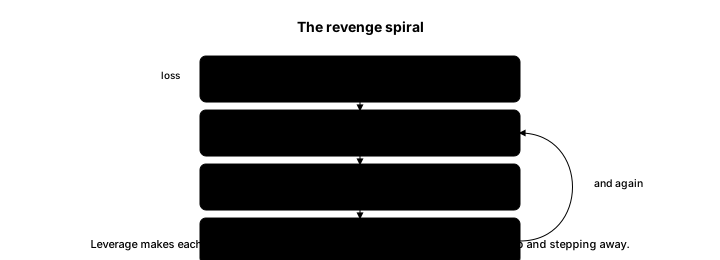
Trading from tilt is revenge trading, and it spirals with a horrible logic. You size up to win the loss back fast, so the next loss is bigger, which deepens the anger, which sizes up the trade after that. You met the arithmetic of this spiral in the chapter on loss limits: three ordinary 2,000 rupee losses, survivable on their own, became a 36,000 rupee hole, 18% of the account, once revenge doubled and redoubled the size. With leverage it is faster still, because the bigger positions tilt reaches for are exactly the ones an ordinary move can destroy. Tilt is dangerous in cash and lethal in futures.
Two familiar habits are really revenge trading in slow motion. One is sunk-cost thinking: refusing to abandon a losing trade because of how much you have already put into it, as though the money already lost could be recovered by risking more. It cannot. The loss is gone whatever you do next, and the only real question is the trade in front of you now. The other is averaging down, buying more of a falling position to lower your average price. It sounds clever and feels proactive, but it does the one thing all of risk management forbids: it makes your position bigger exactly when the trade is proving you wrong.
What averaging a loser actually does
See it in numbers. You buy 100 shares of a stock at 1,400. Your plan's stop was 1,370, a 3,000 rupee risk. But the stock falls and, instead of taking the stop, tilt whispers that it is a bargain now, so you buy 100 more at 1,300 to bring your average down to 1,350. You feel better; your average is lower. Then the stock keeps falling to 1,200. You now hold 200 shares showing a loss of 30,000 rupees, ten times the 3,000 you had planned to risk, because averaging down turned one disciplined loss into a double-sized disaster. You did not reduce your risk. You doubled it, at the worst possible moment, to soothe a feeling.
Breaking the spiral
You cannot reason your way out of tilt while you are on it, any more than you can win an argument while furious. The break has to be mechanical and decided in advance. The loss limit from Part 2 is the primary circuit breaker: when you hit your daily maximum, you are done, and tilt does not get a vote. Beyond that, the rule is physical. Step away from the screen. Stand up, leave the desk, end the session. The urge to get even fades quickly once you are no longer staring at the thing you want revenge on. Come back tomorrow, when the calm version of you can look at what happened.
The professional's attitude is the quiet one: a loss taken by plan is not an insult to answer, it is a cost of doing business, already budgeted for. There is nothing to win back, because nothing was taken that you had not already agreed to risk. That reframing, more than any technique, is what keeps the hot thought from ever forming.
What to carry forward
Tilt is the emotional state after a loss in which you abandon your plan to win the money back, and revenge trading, over-sizing, sunk-cost thinking, and averaging into losers, is how it turns a manageable loss into a ruinous one, with leverage making the fall faster. The arithmetic is brutal: averaging a loser turned a planned 3,000 rupee loss into 30,000. Because you cannot argue with tilt in the moment, the defences are mechanical and pre-set: hit your loss limit and stop, then physically walk away.
That closes Part 3, the tour of the mind's traps, from fear and greed through the biases to tilt. Knowing the traps is not the same as being free of them. Part 4 turns to the deliberate habits that build real discipline, starting with the shift from judging your results to judging your process.