Course contents
The most important number you set
Position sizing decides how much you can lose on a trade, which makes it the single most important risk decision you make. Risking a small, fixed share of your capital per trade is what keeps you in the game.
- Explain risking a small fixed percentage (commonly 1 to 2%) of capital per trade
- Calculate a position size from the capital at risk and the stop distance, with a worked Indian example
- Connect sizing back to the risk of ruin
Two traders each have 2,00,000 rupees, and both want to buy the same stock. The first asks the only question most beginners ever ask: how many shares can I afford? The second asks a completely different question: how much am I willing to lose if I am wrong? Those two questions lead to wildly different trades, and the gap between them is most of the difference between a trader who lasts and one who does not.
The number that is not the number you think
Most beginners believe the important decision is which stock to buy. It is not. By far the most important number you set on any trade is your position size, the quantity you buy or sell, chosen so that a loss, if it comes, is an amount you decided in advance. Position sizing is how you turn the vague instruction "manage your risk" into a specific number of shares. Everything else in this part, stops, reward-to-risk, loss limits, only works once your size is under control.
Risk a small, fixed slice
The professional's rule is simple and unglamorous: risk only a small, fixed percentage of your capital on any single trade, commonly 1 to 2%. This is not the amount you invest. It is the amount you lose if the trade goes against you and you exit at your stop. On a 2,00,000 rupee account, 1% is 2,000 rupees. That 2,000, your capital at risk, is the most you intend to lose on the trade, however large the position itself may be.
You already saw why the number is kept small. In the chapter on the risk of ruin, risking 2% per trade left you with about 82% of your capital even after ten straight losses, while risking 25% all but wiped you out. Risk 1% and even a brutal ten-loss streak costs you only about 10% of your account, a dip you can recover from. Small per-trade risk is not timidity. It is what makes a losing streak survivable, and the last part showed that a losing streak is a certainty, not a possibility.
Working out the size
Here is how you turn the capital at risk into a share count. You need two numbers: how much you will risk in rupees, and how far the price has to move against you before you admit you are wrong and exit. That second number, the distance from your entry to your stop-loss, is the subject of the next chapter. For now, take it as given. The position size is simply the first number divided by the second.
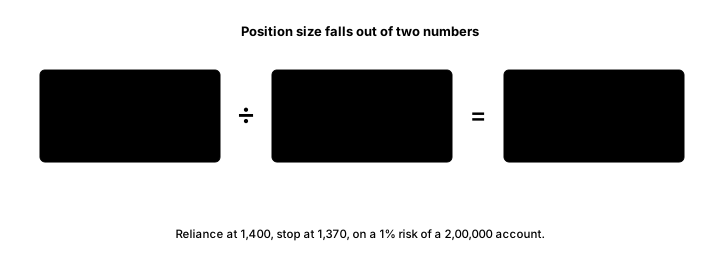
Position size = capital at risk divided by the stop distance per share
Suppose you buy Reliance at 1,400 rupees, and you decide that if it falls to 1,370 your reason for buying is broken, so that is where you will exit. Your stop distance is 30 rupees per share. With 2,000 rupees of capital at risk, your position size is 2,000 divided by 30, which is about 66 shares. Buy 66 shares, and if the stock hits 1,370 you lose 66 times 30, which is 1,980 rupees, almost exactly the 1% you chose. (All figures illustrative.)
Now look at what those 66 shares actually cost: 66 times 1,400, or 92,400 rupees. You have put 92,400 into the position, but you have only 2,000 at risk, because your stop caps the loss. This is the distinction beginners miss. The size of the position and the amount you can lose are two different numbers. You control the second one directly, through your stop and your share count, and you refuse to let it grow past your 1%.
One more consequence, and it surprises people. Because size is capital at risk divided by stop distance, a wider stop means a smaller position, and a tighter stop means a larger one, for the exact same 2,000 rupees at risk.
| Stop distance | Shares (2,000 at risk) | Position value | Loss if stopped |
|---|---|---|---|
| 15 rupees | 133 | 1,86,200 | about 2,000 |
| 30 rupees | 66 | 92,400 | about 2,000 |
| 60 rupees | 33 | 46,200 | about 2,000 |
The market decides how much room a trade needs. Your risk rule decides the rupees. Those two together, not your excitement about the stock, decide how many shares you buy.
What to carry forward
Position size is the single most important risk decision, and it comes from two numbers: a small fixed slice of capital you are willing to risk, and the distance to the point where you would admit the trade is wrong. Divide the first by the second and you have your share count, with the loss capped at the 1 or 2% you chose, however large the position looks. Keeping that per-trade risk small is exactly what makes the inevitable losing streak survivable.
All of this rests on one number we borrowed without explaining: the stop distance. The next chapter is about where that stop goes, why it must be set before you enter, and why moving it is the most expensive habit in trading.