Course contents
Cutting winners, riding losers
We feel a loss about twice as hard as an equal gain, which pushes us to grab small profits too soon and cling to losing trades hoping they recover. This backwards instinct, the disposition effect, is one of the costliest in trading.
- Explain loss aversion and the disposition effect
- Show why it makes traders cut winners and hold losers
- Give the correction, letting winners run and cutting losers by the plan
You have two open trades. One is up 2,000 rupees, the other is down 2,000. You have to close one. Almost everyone, asked quickly, closes the winner. Booking the gain feels responsible, and closing the loser feels like admitting defeat, so you keep the loser and hope. Notice what you just did: you sold the trade that was working and kept the one that was not. If that instinct feels natural, that is exactly the problem, because it is one of the most expensive instincts in trading and it runs precisely backwards.
Why a loss weighs more
The instinct has a root and a name. Human beings feel losses more intensely than equal gains. Research into how people actually make decisions found that the pain of losing a sum is roughly twice as strong as the pleasure of gaining the same sum. This lopsided feeling is called loss aversion: a 2,000 rupee loss hurts about twice as much as a 2,000 rupee gain feels good.
Loss aversion is not stupidity, it is wiring, and outside the market it often serves you well. But inside a trade it produces a specific, damaging pattern. Because a paper loss hurts so much, you do almost anything to avoid making it final, including holding a losing trade far past the point your plan said to exit, telling yourself it will come back. And because a paper gain could turn back into nothing, and that reversal would sting, you snatch the gain early to make it safe. Fear of the pain drives both halves.
The disposition effect
This combined habit, selling winners too early and holding losers too long, is documented well enough to have its own name: the disposition effect. Studies of real brokerage accounts, in India and elsewhere, find that ordinary investors are far more likely to sell a position that is up than one that is down, even when the losing position is the one they should let go. It feels like prudence. It is the opposite.
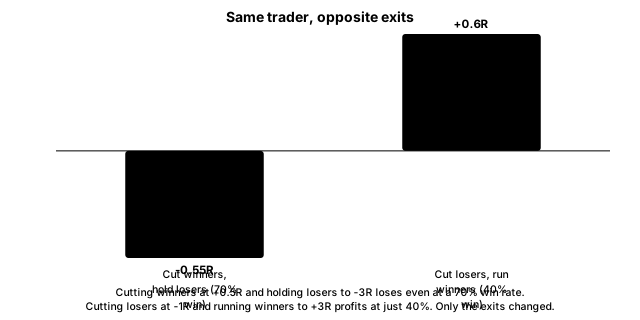
Here is why it is so destructive, in the language of Part 2. Everything you learned about expectancy and reward-to-risk assumed your winners would be allowed to grow larger than your losers. The disposition effect does the reverse: it shrinks your winners and swells your losers. Suppose that, left alone, you are actually a good trader who wins 70% of the time. But you cut every winner at half your risk unit, a mere plus 0.5R, while you hold every loser to three times your risk, minus 3R, because you cannot take the loss. Your expectancy is 0.7 times 0.5, minus 0.3 times 3, which is minus 0.55R per trade. A 70% win rate, and you lose steadily, purely because of when you exit.
Reversing it by rule
Now reverse the habit and watch the same trader transform. Cut losers at your planned minus 1R, and let winners run to plus 3R, the honest reward-to-risk from Part 2. Even at a much lower 40% win rate, your expectancy becomes 0.4 times 3, minus 0.6 times 1, which is plus 0.6R per trade. The trading skill did not change. Only the discipline of the exits did, and it flipped a losing account into a winning one.
You cannot argue yourself out of loss aversion in the moment, because the feeling is real and it is loud. What you can do is decide the exits in advance and remove the choice, which is exactly what the stop-loss and the target from Part 2 are for. The stop takes the losing decision out of your trembling hands. The target, or a trailing stop that follows a winner up, protects the gain without your fear cashing it in early. The plan is not there to make you smarter. It is there to save you from a feeling you cannot switch off.
What to carry forward
Loss aversion means a loss hurts about twice as much as an equal gain feels good, and it drives the disposition effect: selling winners early to make the gain safe, and holding losers to avoid making the loss real. That habit quietly reverses your reward-to-risk and can turn even a high win rate into a loss, as the arithmetic showed. The fix is not to feel differently but to decide your exits in advance and let the stop and the target enforce them.
Loss aversion is one distortion, and it changes when you exit. There are others, quieter ones, that warp what you see in the first place. The next chapter lines up the mental shortcuts that fool you into seeing what you already want to see.