Course contents
The urge to always be doing something
The fear of missing out drags traders into moves they did not plan, and the urge to always be in the market leads to overtrading, which multiplies costs and mistakes. Often the best trade is no trade.
- Explain FOMO and how it causes unplanned, chased entries
- Explain overtrading and its costs
- Make the case that sitting in cash is a legitimate and often correct position
A stock you do not own is running. It is up 8% today, it is all over your feed, and a voice in your head says everyone is making money on this except you. Your fingers move toward the buy button for a trade that is nowhere in your plan, at a price far above where any sensible entry would have been. That voice is the fear of missing out, and it is responsible for more bad entries than any faulty analysis, because it makes you buy things for the single reason that they have already gone up.
The fear of missing out
The fear of missing out, or FOMO, is the discomfort of watching others apparently profit from a move you are not in. It is greed and fear fused into one: greed for the gain, and fear of being left behind. In the market it produces a very specific mistake, chasing, which means buying after a move has already happened, at a worse price, without a plan and usually without a stop, because the decision was emotional and instant.
Chasing is dangerous for a plain reason. The move that triggered your FOMO is, by definition, already in the past. You are buying high, late, and unprepared, often right as the early buyers are selling to people exactly like you. The trades that match your plan rarely feel urgent; the ones that scream at you to hurry are almost always the ones to distrust. Urgency is a symptom, not a signal.
The urge to always be trading
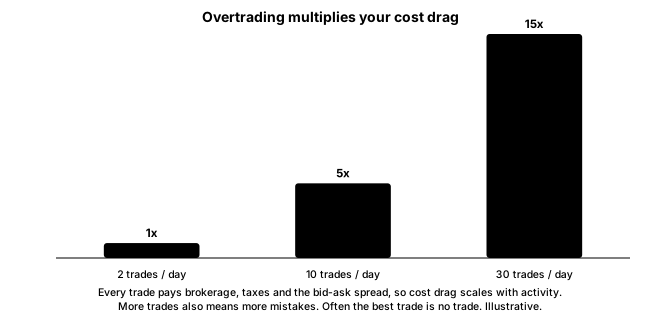
FOMO has a quieter, more chronic cousin: overtrading, the urge to always be in the market, doing something. It comes from boredom, from impatience, from the feeling that a real trader is always active, and from the sense that watching and waiting is somehow wasted time. So you take marginal trades that do not meet your criteria, just to be in something. Each one seems harmless. Together they are corrosive, and not only because low-quality trades lose more often.
Overtrading carries a cost that is easy to ignore because it arrives in small pieces: the cost of trading itself. Every trade pays brokerage, taxes such as the securities transaction tax, exchange fees, and the bid-ask spread. Suppose, illustratively, that a full round trip costs about 0.10% of the trade's value. A disciplined trader who takes 100 trades a year of 1,00,000 rupees each pays about 10,000 rupees in costs over the year. An overtrader making 1,000 such trades pays about 1,00,000, which on a 2,00,000 rupee account is half the capital, gone to costs alone, before the market has decided a single winner or loser. (Cost figures illustrative; confirm current charges.) Studies of Indian traders have found that trading costs are a large part of why active traders end up in the red. Activity feels like progress. Often it is just leakage.
No position is a position
The correction is a reframing that beginners find surprisingly hard: sitting in cash, waiting, is a legitimate and often correct position. You are not paid for activity. You are paid for taking good trades and avoiding bad ones, and most of the time there is no good trade on offer that matches your plan. A professional can go days without trading and feel no discomfort, because they know that not taking a bad setup is itself a winning decision. The urge to always be doing something is the enemy of that patience, and patience, as the next part will argue, is one of the most profitable skills a trader owns.
The practical defences are simple. Trade only setups written into your plan, so a move you did not foresee has no claim on you. When you feel the pull to chase, name it as FOMO and wait, because a genuine opportunity will usually give you another entry and a mirage will not. And count no-trade days as good days, not wasted ones.
What to carry forward
The fear of missing out drags you into chasing moves that are already over, buying high and late without a plan, and its cousin overtrading fills your days with marginal trades whose costs alone can consume a large share of your capital. The antidote is patience and selectivity: trade only what your plan defines, distrust urgency, and treat sitting in cash as the sound decision it usually is.
There is one emotional trap left, and it is the most dangerous, because it turns an ordinary loss into a compulsion to strike back. The next chapter is about tilt, the state a painful loss puts you in, and the revenge trading that has ended more accounts than any market crash.