Course contents
What an edge actually is
An edge is not a high win rate. It is positive expectancy, the average result per trade once wins and losses are weighed together. You can be right less than half the time and make money, or right almost every time and lose it.
- Define expectancy as win rate times average win minus loss rate times average loss
- Show a worked example where a sub-50% win rate is still profitable
- Explain why chasing a high win rate can destroy expectancy
In the first chapter you met a trader who was right on seven of ten trades and still lost money, because the three losses were each far bigger than the seven wins. That was not a paradox or a piece of bad luck. It was ordinary arithmetic, and it points straight at the most misunderstood idea in trading: what an edge actually is. Most beginners believe an edge means being right often. It does not. You can be right most of the time and lose, or right rarely and win. What matters is a single number that weighs both sides together.
Expectancy, the number that decides
That number is called expectancy. Expectancy is the average amount you can expect to make or lose per trade, once you account for both how often you win and how much you win or lose each time. In plain words:
Expectancy per trade = (win rate x average win) minus (loss rate x average loss)
If that number is positive, you have an edge. Repeated many times, the trades make money on average. If it is negative, you do not have an edge, and repeating the trades simply feeds your capital to the market, however clever any single trade felt at the time.
Right less than half the time, and still ahead
Here is why win rate alone tells you almost nothing. Suppose you win only 40% of your trades. Six out of every ten are losers. It sounds like a system to abandon. But suppose each win makes 3,000 rupees on average, while each loss costs only 1,000, because you cut losers quickly and let winners run. Work the expectancy. Across ten trades, four wins bring in four times 3,000, which is 12,000 rupees. Six losses cost six times 1,000, which is 6,000. You are ahead by 6,000 over ten trades, or 600 rupees per trade of positive expectancy. Losing 60% of the time, you still make money, steadily, as long as you keep taking the trade.
Now the mirror image, the one that fools people. Suppose you win an impressive 90% of the time. Nine trades out of ten are winners. But each win earns only 500 rupees, while each rare loss costs 6,000, because you hold losers and hope, refusing the small loss until it becomes a large one. Work it out. Across ten trades, nine wins bring in nine times 500, which is 4,500 rupees. The single loss costs 6,000. You are down 1,500 over ten trades, which is minus 150 rupees per trade. A 90% win rate, and you lose money every ten trades like clockwork.
| System | Win rate | Average win | Average loss | Expectancy per trade | Over 100 trades |
|---|---|---|---|---|---|
| A | 40% | 3,000 | 1,000 | plus 600 | plus 60,000 |
| B | 90% | 500 | 6,000 | minus 150 | minus 15,000 |
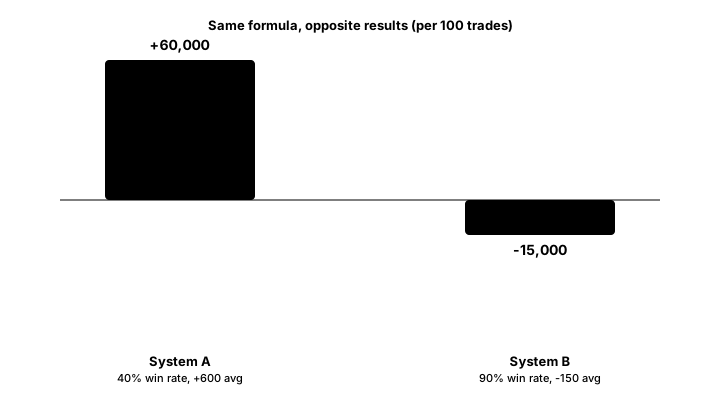
Side by side, the two systems demolish the idea that being right often is the goal. System A is wrong most of the time and mints money. System B is right almost always and bleeds. The difference is entirely in the size of the wins against the losses, not the frequency of them.
Why chasing a high win rate can destroy your edge
This is not a mere curiosity, because the urge to be right is one of the strongest pulls in trading, and it quietly leads people to build System B on purpose. It feels wonderful to win nine trades out of ten, so traders take profits early to lock in the pleasant feeling of a win, and they refuse to close a loser because taking the loss would spoil the record. Both habits do exactly what System B shows. They shrink the wins and swell the losses, turning a high win rate into negative expectancy. Chasing the feeling of being right is one of the most reliable ways to lose money in the market.
There is a shortcut worth carrying into Part 2. The size of your average win compared with your average loss is called the reward-to-risk of a trade, and it works together with your win rate to set your expectancy. The larger your winners are relative to your losers, the lower the win rate you need just to break even. If your average win is three times your average loss, a reward-to-risk of three to one, you only need to be right about a quarter of the time to break even. If your wins and losses are the same size, you need to be right half the time. And if, like System B, your wins are tiny next to your losses, you need to be right almost always, which is why System B was doomed from the start. The full treatment of reward-to-risk is a chapter of its own in Part 2.
What to carry forward
An edge is not being right often. It is positive expectancy: your win rate and the size of your wins and losses, weighed together into a single average result per trade. A 40% win rate can be an edge, and a 90% win rate can be a losing habit, because the size of wins against losses decides everything, and reward-to-risk is the lever that lets a low win rate still pay. Chasing the pleasure of being right shrinks winners and grows losers, which is how a trader builds a losing system while feeling like they are winning.
That closes Part 1, which made one case in four steps: survival, not prediction, is the trader's real job. Losses are asymmetric and must be kept small. A losing streak is certain and must be sized for. And your edge is a matter of expectancy rather than accuracy. Part 2 turns these truths into tools you can use before every trade. It starts with the most important number you will ever set, the one this part kept pointing to: position size, and how to work it out from your capital and your stop.