Course contents
What trading can and cannot do for you
The regulator's own data says most individual traders lose, and get-rich-quick is a fantasy the industry sells and the market punishes. Realistic expectations, slow, consistent, and hard-won, are themselves a form of risk management.
- Present the regulator's loss statistics honestly
- Contrast the get-rich-quick pitch with the reality of slow compounding and high failure rates
- Frame modest, realistic goals as protective
Open any trading app's advertising, or any finance influencer's feed, and you are sold a picture: a young person on a beach, a laptop, a chart going up, freedom bought in a few months of clever trades. This chapter is the honest counterweight to that picture, and it uses the same regulator's data the course opened with, because the single most protective thing you can carry into the market is a realistic idea of what it can and cannot do for you.
Start with the numbers, again
You met the central fact in the first chapter, and it belongs here too, because Part 5 is where the course settles its accounts with honesty. India's regulator, SEBI, found that around nine in ten individual traders in equity futures and options lose money, with individuals' losses running past 1.8 lakh crore rupees, and that roughly seven in ten intraday cash-market traders lose as well.
These are not the numbers a beach advertisement wants you to see. They describe an activity where the large majority lose, and they are the base rate you are joining, not an unlucky fringe. Realistic expectations begin with accepting that the default outcome of active trading, statistically, is a loss, and that avoiding that outcome takes exactly the risk control and discipline this whole course has taught.
Why get-rich-quick is arithmetic, not caution
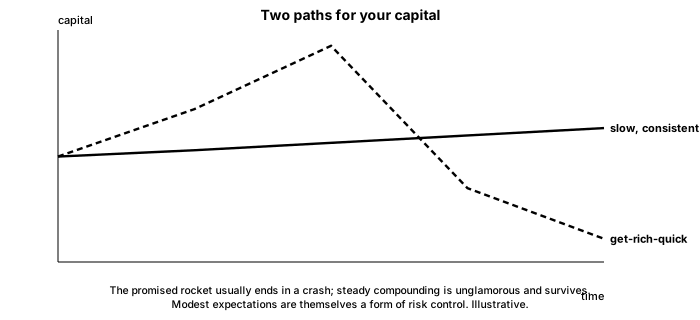
The get-rich-quick pitch is not merely unlikely, it is arithmetically impossible at the rates it implies, and seeing why frees you from it for good. Suppose someone promises, or you quietly hope for, 10% a month. It sounds modest, a single good trade's worth. Compounded, 10% a month turns 1,00,000 rupees into about 3,14,000 in a year, and, left to run for ten years, into more than 900 crore rupees. If that rate were real and repeatable, every person who could do it would own the entire market within a few years. Nobody does, because nobody can. The impossibility of the ten-year figure is the proof that the one-month rate was never sustainable.
Now the honest benchmark. The stock market itself has historically returned something in the region of low double digits a year over the long run (illustrative; confirm at publish). Even the most celebrated investors in the world have compounded at roughly the high teens to low twenties percent a year over their careers, and that has been enough to make them legends, because of what compounding does with time, not speed. At 12% a year, money doubles in about six years. At 20% a year, a very high bar, 1,00,000 becomes about 6,00,000 over a decade. That is the real shape of building wealth in markets: slow, compounding, and measured in years, not the percent-a-day fantasy the industry sells.
Modest expectations are a risk control
Here is why this belongs in a risk course rather than a motivational one. Your expectations set your behaviour. A trader who expects to double their money this month will size enormously, chase, and revenge trade to hit an impossible target, and will blow up trying. A trader who expects a modest return, or who is simply trying to trade well and not lose, sizes sensibly, waits for good setups, and survives. Unrealistic expectations are not just disappointing. They are directly dangerous, because they push you into every mistake in Parts 2 and 3 at once.
So set expectations that keep you alive. Aim first not to lose, then to make a modest, consistent return, and let compounding and time do the rest. Treat any month you followed your rules and protected your capital as a success, regardless of the profit. The traders who are still standing in five years are almost never the ones who chased the beach. They are the ones who expected little, protected much, and let a small edge compound.
What to carry forward
The honest picture is the protective one: most individual traders lose, get-rich-quick is impossible at the rates it promises, and real market wealth is slow, compounding, and measured in years. Your expectations drive your behaviour, so unrealistic ones push you straight into over-sizing and revenge trading, while modest ones keep you sized sensibly and alive. Aim to survive first and compound a small edge second.
If wealth from trading is slow and hard-won, then trading is best treated not as a jackpot but as a business, run on capital, costs, and expectancy. The next chapter takes up that mindset, and the line it draws between disciplined trading and gambling.