Course contents
How a good trader still goes broke
A losing streak is not bad luck, it is a certainty over enough trades. Bet too large a share of your capital on each trade and an ordinary run of losses will wipe you out, even if your system wins over time. Position size is the defence.
- Explain the risk of ruin in plain terms
- Show how over-betting destroys even a positive-edge trader through an inevitable losing streak
- Introduce position size as the control that prevents it
A casino has a genuine edge over every gambler who walks in. The odds on every table are tilted, by a small but permanent margin, in the house's favour, so given enough bets the casino is mathematically certain to come out ahead. And yet a casino could still go bankrupt in an afternoon, if it did one foolish thing: bet its entire cash reserve on a single spin of the roulette wheel. One unlucky spin, and the surest edge in the world is gone. The casino stays rich not only because it has an edge, but because it never lets any one bet be large enough to ruin it.
A trader who bets too much on each trade is the casino wagering its whole reserve on one spin. The edge, if there is one, stops mattering, because you can be knocked out before it has time to work. This is the risk of ruin, and it is one of the few ideas in trading that sits closer to certainty than to probability.
A losing streak is not bad luck, it is a certainty
Beginners think of a long run of losses as a freak event, the kind of thing that happens to other people. The arithmetic says otherwise. Flip a fair coin two hundred times and you are more likely than not to see a run of six heads in a row somewhere in there, roughly a four-in-five chance, and a run of seven is close to a coin flip in its own right. Trades behave the same way. Over a couple of hundred trades, which an active trader can take in a few months, a losing streak of six or seven in a row is not misfortune. It is the expected weather. The only real questions are when it arrives and whether your account is sized to survive it.
What over-betting does to a losing streak
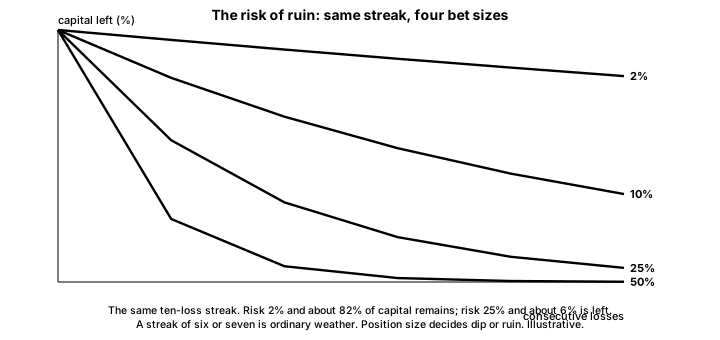
Now put a losing streak together with bet size, and you see why size decides everything. Suppose two traders both hit the same run of ten losing trades. The first risks 2% of whatever is in the account on each trade. The second risks 25%. Watch what the identical streak does to each.
| Risked on each trade | Capital left after 10 losses in a row |
|---|---|
| 2% | about 82% |
| 10% | about 35% |
| 25% | about 6% |
| 50% | about 0.1% |
The trader risking 2% barely notices. After ten straight losses, an unusually bad run, they still hold about 82% of their capital and are well within reach of recovery. The trader risking 25% per trade has about 6% left. They have been all but wiped out, not by being wrong about the market in some special way, but by the same losing streak the careful trader shrugged off. Same streak, same market. The only difference was how much rode on each trade.
Make it concrete. You start with 5,00,000 rupees and you risk a quarter of whatever is left on each trade. A losing streak of eight arrives, which as we just saw is nothing exotic. After it, your 5,00,000 has become about 50,000. You have lost 90% of your account. And you already know from the last chapter what a 90% loss demands to recover: a 900% gain, a ten-fold return, just to get back to where you began. The oversized bet did not merely cost you money. It moved recovery out of reach.
The risk of ruin, named
The risk of ruin is the probability that a string of losses drops your capital so low that you cannot continue, either because the money is effectively gone or because you can no longer meet the margin to hold a position. The unsettling part is that this risk can be high even when your system makes money on average. Edge does not save you if the bet is too big, because ruin is permanent and the edge needs time you no longer have. Bet small enough and the risk of ruin shrinks toward zero. Bet big enough and it climbs toward certainty, whatever your win rate.
The one control that fixes it
There is a single lever that controls the risk of ruin, and it is not your win rate or your skill at forecasting. It is position size: how much of your capital you put at risk on any one trade. Keep the amount risked per trade small, a fixed slice of your capital, and no ordinary losing streak can take you out, because each individual loss is survivable and the streak merely chips at you rather than shattering you.
This is why professionals treat position size as the most important decision they make, ahead of the entry itself. It is the whole subject of an upcoming chapter, and the reason the tools in Part 2 begin there.
What to carry forward
A run of losses is not bad luck to be hoped away. It is a certainty to be planned for, and over a few hundred trades a streak of six or seven is simply the weather. What decides whether that streak is a dip or the end is position size, the share of your capital you put at risk each time. Bet a small fixed slice and you survive. Bet a large one and an ordinary streak takes you to a 90% loss and a 900% climb back. Edge alone will not save an over-bettor, because ruin does not wait for the edge to work.
That raises the question the next chapter answers: what is an edge, really? It is not a high win rate, as the first chapter hinted. The next chapter gives it its true name, expectancy, and shows how you can be right less than half the time and still come out ahead.