Course contents
A circuit breaker for yourself
Beyond the risk on a single trade, set a limit on how much you will lose in a day or a week, and stop when you hit it. It is a circuit breaker against a bad day becoming a ruinous one.
- Explain daily and weekly maximum-loss limits
- Show how a loss limit prevents a bad session from spiralling
- Connect stopping for the day to the psychology of tilt covered later
When a stock or an index falls too far too fast, the exchange halts trading in it for a while. This is a circuit breaker, and its purpose is to force a pause before panic feeds on itself. You need the same thing for your own account, because on a bad day the fastest route to a disaster is to keep trading through it. A loss limit is your personal circuit breaker.
Two limits above the trade
Position sizing and stops control the risk on each individual trade. A loss limit sits one level up. It caps how much you are willing to lose across a whole day or week, no matter how many trades that takes. Set a daily maximum loss, and when your losses for the day reach it, you stop trading until tomorrow. Set a weekly one too, and when you hit that, you are done for the week.
A common shape, on the 2,00,000 rupee account we have been using, is a daily limit of about 3% and a weekly limit of about 6%. Three percent of 2,00,000 is 6,000 rupees, which is exactly three of your 2,000-rupee full stops. So the rule reads: three losing trades in a day, and you are finished for the day. It sounds strict. It is meant to.
Why a limit matters: the spiral
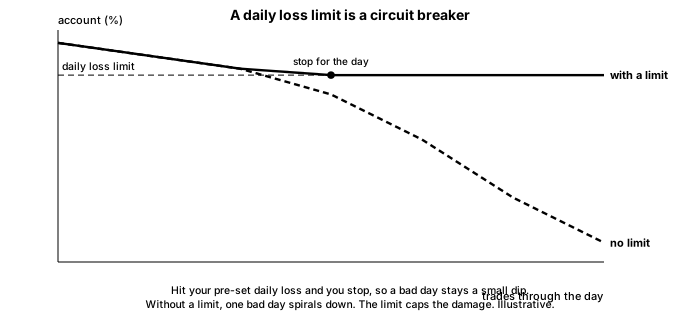
Here is what a loss limit prevents. Imagine a morning where three good trades all fail, and you are down your 6,000. That is an ordinary, survivable bad start, well within the math of the earlier chapters. But without a limit, this is exactly the moment the trouble begins. Stung and wanting it back, you take a fourth trade, bigger this time, then a fifth, bigger still, sizing by emotion instead of your 1% rule. Say those revenge trades run at 5% each, 10,000 a time, and three of them lose. That is another 30,000 gone. Your ordinary 6,000 bad start has become a 36,000 loss, 18% of your account, needing a 22% gain to repair. The losing trades did not do that. The refusal to stop did.
With the limit, the same day ends at minus 6,000, a 3% dip that a 3.1% gain restores. The limit turns a potential account-wrecking session into a small, forgettable one. Its entire job is to remove the decision to keep going from the version of you least able to make it well.
Stopping is a skill
Walking away after hitting your limit is harder than it sounds, because the urge to trade back a loss is one of the strongest in the market. That urge has a name, tilt, and a whole chapter later in this course is devoted to it. For now, the loss limit is the practical defence: a number decided in advance that ends the session for you, so you do not have to win an argument with yourself while you are angry.
The best traders treat hitting the daily limit not as a failure but as the system working. The day is over, the damage is capped, and tomorrow the account is still there to trade. When you stop, step away from the screen entirely, and leave any review of what went wrong for later, when you are calm, which is a habit the chapter on the trading journal will build.
What to carry forward
A loss limit is a circuit breaker for yourself: a daily and weekly cap on losses that ends your session before a bad day becomes a ruinous one. On our example account, three full stops in a day, about 3%, is the signal to stop, which keeps an ordinary losing day small and recoverable instead of letting it spiral into an 18% hole. The limit works because it is decided in advance and takes the choice away from the heated moment, a defence against the tilt this course returns to later.
So far you have protected each trade and each session. The next chapter widens the view to all your positions at once, and the trap of holding several bets that are secretly the same bet.