Course contents
Is the trade worth taking
Before entering, weigh what you can lose against what you can reasonably make, the reward-to-risk ratio. It works hand in hand with your win rate to decide whether a trade is worth taking at all.
- Define reward-to-risk and compute it for a trade
- Explain how reward-to-risk and win rate together determine expectancy
- Explain why a poor reward-to-risk needs a very high win rate to survive
You have two trades in front of you, and you like both. In the first, you risk 30 rupees a share to aim for 90. In the second, you risk the same 30 to aim for 15. Even if you felt equally confident about both, only one of them is worth taking, and the reason has nothing to do with confidence. It is arithmetic, and it is the last check you run before any trade.
Weighing reward against risk
You met the idea briefly in Part 1. The reward-to-risk of a trade is how much you stand to gain if it works, divided by how much you will lose if it fails. Both come from prices you can read before you enter: your risk is the distance from entry to stop, and your reward is the distance from entry to a realistic target.
Take the Reliance trade from the last two chapters. You buy at 1,400 with a stop at 1,370, so your risk is 30 rupees. Suppose the next resistance level, a sensible target, sits at 1,490. Your reward is 90 rupees. Ninety divided by thirty is three, so this trade offers a reward-to-risk of three to one. You are risking one rupee to make three. Now the second trade, with a target of only 1,415: a reward of 15 against a risk of 30, a ratio of 0.5 to one, risking two rupees to make one. Same stock, same risk, and a completely different trade.
The ratio and your win rate decide together
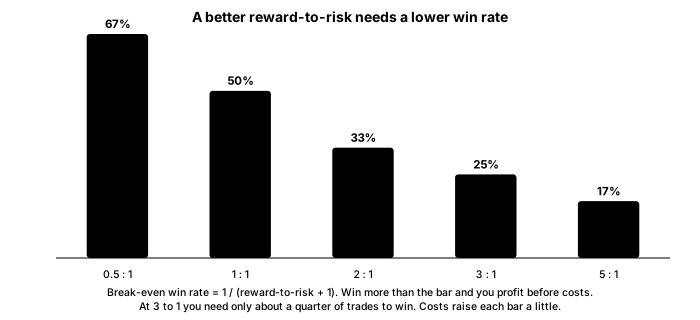
Reward-to-risk does not work alone. It teams up with your win rate to produce the expectancy you met in Part 1, the average result per trade. A generous reward-to-risk lowers the win rate you need, because your winners are large enough to pay for several losers. There is a clean break-even line: with a reward-to-risk of R to one, you need to win more than one divided by (R plus one) of the time just to break even before costs.
Run it. At three to one, your break-even win rate is one divided by four, which is 25%. Win more than a quarter of these trades and you make money. At the second trade's 0.5 to one, the break-even win rate is one divided by 1.5, which is about 67%. You would have to win two out of every three just to stay level.
| Trade | Risk | Reward | Reward-to-risk | Win rate needed to break even |
|---|---|---|---|---|
| A, target 1,490 | 30 | 90 | 3 to 1 | 25% |
| B, target 1,415 | 30 | 15 | 0.5 to 1 | 67% |
The first trade forgives you for being wrong most of the time. The second punishes you unless you are right almost always.
Thinking in R
There is a habit that ties this whole part together. Measure every trade in units of the amount you risked, called R. If you risk 2,000 rupees, then one R is 2,000. A trade that makes three times your risk is a plus 3R win. A trade stopped out is a minus 1R loss. Thinking in R frees you from rupee amounts and lets you judge single trades and whole months on one scale.
It also makes expectancy concrete. With the three-to-one trade and, say, a 40% win rate, your expectancy is 0.4 times 3R minus 0.6 times 1R, which is plus 0.6R per trade. On 2,000 rupees of risk, that is 1,200 rupees of expected profit every time you take the trade, even though you lose it 60% of the time. That is what a good reward-to-risk buys you: the freedom to be wrong often and still come out ahead.
The honest catch
One warning keeps this from becoming a trick. The reward is only real if the target is realistic. It is easy to invent a beautiful reward-to-risk by drawing your target far away, where you would love the price to go, then congratulating yourself on a five-to-one trade that never had a chance of reaching it. The risk, set by your stop, is a fact. The reward is an estimate, and an honest trader sets it at a level the price can plausibly reach, not at a wish. A modest, believable reward-to-risk you actually hit beats a spectacular one you invent.
What to carry forward
Before any trade, weigh the reward you can realistically reach against the risk your stop defines. That ratio, working with your win rate, sets your expectancy: a three-to-one trade needs you to be right only a quarter of the time, while a half-to-one trade needs two wins in three. Measure trades in R, the multiple of what you risked, and keep your targets honest, because the risk is fixed but the reward is a guess.
So far every tool has controlled a single trade. But a run of single trades on one bad day can still hurt you, even when each was sized and stopped correctly. The next chapter adds the control that sits above the trade: a limit on how much you will lose in a day or a week, and the discipline to stop when you hit it.