Course contents
Waiting for your pitch
Most of the time there is no good trade to make, and the discipline to wait for your own setup, rather than manufacture activity, is what separates consistent traders from busy ones.
- Explain why waiting is an active skill
- Contrast trading your plan's setups with trading out of boredom
- Reinforce that no position is a position
There is a famous piece of investing advice borrowed from baseball. A batter at the plate must swing at pitches near the strike zone or be called out, but an investor faces no such rule. You can stand at the plate as long as you like, letting pitch after pitch go by, waiting for the one that is exactly in your zone, and no umpire will ever call a strike on you for waiting. The only way to lose this game is to swing at bad pitches. And yet the hardest thing for most traders to do is stand still and let the bad pitches pass.
Waiting is a skill, not a gap
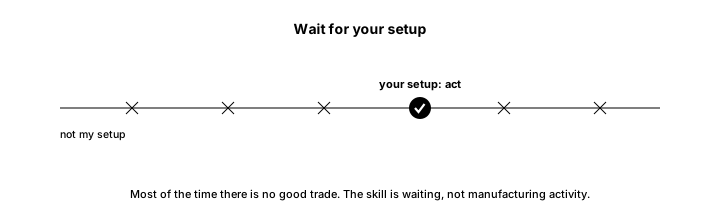
Beginners think of trading as the act of placing trades, so time spent not trading feels wasted, like failing to do the job. This is backwards. The job is not to trade. The job is to make good decisions with your capital, and most of the time the best available decision is to do nothing, because no setup that matches your plan is on offer. Waiting for that setup is not the absence of trading. It is the most important part of it, an active choice to preserve your capital and your attention for the moment they are actually worth spending.
The market does not pay you for hours logged or trades placed. It pays you for being in the right trades and, just as much, for not being in the wrong ones. A day spent watching, finding nothing that qualifies, and placing no trade is not a failed day. It is a disciplined one, and often your most profitable, because the losses you did not take are as real as the gains you did.
What boredom trades cost
The enemy of patience is the boredom trade, the marginal setup you take not because it is good but because you are restless and want to be in something. Each one feels minor. Together they quietly consume your edge, and the arithmetic is unforgiving. Suppose your genuine A-setups are worth plus 0.6R each, and you take five of them in a month. That is plus 3R of hard-won edge. Now suppose boredom leads you to pad the month with fifteen marginal trades, each a small money-loser at minus 0.2R. Those fifteen add up to minus 3R, which exactly cancels the profit from your five good trades. A month of real work, erased by trades you took only to feel busy.
This is the same lesson as overtrading from Part 3, seen from the trader's chair rather than the cost sheet. The marginal trade is not free even when it nearly breaks even, because it spends your attention, your capital, and your self-control on something with no edge, and it crowds out the patience you needed for the trade that mattered.
No position is a position
Hold on to the phrase from Part 2: no position is a position. Being in cash, waiting, is a deliberate stance, not a failure to act. The consistent traders are almost always the selective ones, the people who do far less than a beginner imagines a trader does, and who guard their capital fiercely for the few moments it is worth risking. Fewer, better trades beats more, worse ones, every time, and the ability to sit on your hands is the skill that makes it possible.
The practical discipline is to define your setups tightly enough that most of the market's noise simply does not qualify, and then to trust that definition when you are bored. If it is not a pitch in your zone, you let it go by, and you feel no regret, because there is no called strike for waiting.
What to carry forward
Patience is not the absence of trading, it is the core of it: you face no penalty for waiting, so the only way to lose is to swing at bad pitches, and most pitches are bad. Boredom trades feel minor, but their small losses can cancel a month of real edge, which is why the consistent traders are the selective ones who treat sitting in cash as a genuine position. Do fewer, better trades, and trust your setups when you are restless.
Even the most patient, disciplined trader, though, will hit a stretch where the good trades they do take simply lose, one after another. The next chapter is about surviving that, the drawdown, without letting it break either your capital or your composure.