Course contents
Adding up all the risk you carry
Leverage multiplies risk, and several leveraged positions add up to far more exposure than the margin suggests. Managing total exposure across everything you hold is what keeps leverage from ending you.
- Explain how leverage magnifies portfolio risk, connecting to the options and futures courses
- Show how to add up total exposure rather than judging each position alone
- Give a guardrail for total leverage
A futures position has a strange feature that quietly wrecks accounts: it feels small while it is large. You post a margin of under two lakh rupees and control a position worth eighteen lakh. Your account still shows plenty of unused cash, so it feels as though you have barely committed anything. Meanwhile the risk you are carrying is the size of the full eighteen lakh. The gap between what a leveraged position feels like and what it actually is, is where this chapter lives.
Leverage, and the number that hides
You met leverage in the Futures course. It is the ratio of the position you control to the money you put up to control it. One NIFTY futures lot, worth about 15,60,000 rupees, needs a margin of roughly 1,56,000, so it carries leverage of about ten times. The margin is what the position feels like. The contract value is what you are actually exposed to. Judge your risk by the first and you will be undone by the second, because a loss is calculated on the full contract value, not on the margin.
That is one position. The real danger appears when you hold several, because the margins are small and tempt you to stack more on top.
Adding up total exposure
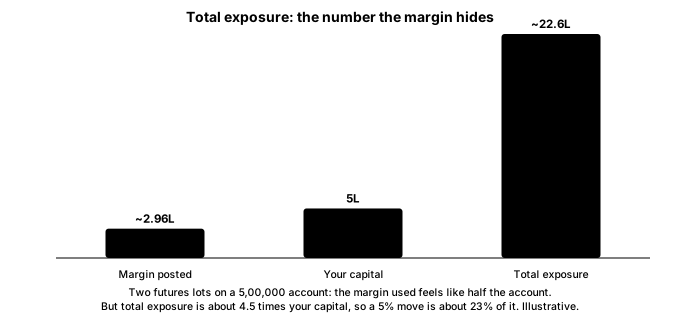
Your total exposure is the sum of the full values of everything you are positioned in, not the sum of the margins you posted. Watch how the two diverge. Suppose you have a 5,00,000 rupee account. You buy one NIFTY futures lot: exposure 15,60,000, on 5,00,000 of capital, already about 3.1 times your account. The margin is only about 1,56,000, so your account still shows over three lakh free, and it feels as if there is room for more. So you add one Reliance futures lot, worth about 7,00,000, margin around 1,40,000.
Now total it up.
| Position | Notional exposure | Margin posted |
|---|---|---|
| 1 NIFTY lot | 15,60,000 | about 1,56,000 |
| 1 Reliance lot | 7,00,000 | about 1,40,000 |
| Total | 22,60,000 | about 2,96,000 |
| Against 5,00,000 capital | about 4.5 times exposure | 59% of account |
Your margin used is about 2,96,000 of your 5,00,000, which feels like a bit over half your account committed, with something still in reserve. But your total exposure is 22,60,000 rupees on a 5,00,000 account. That is about four and a half times your capital riding in the market. A perfectly ordinary 5% adverse move across those positions is 1,13,000 rupees, which is about 23% of your account, gone in a single session, from what felt like a half-used account. (All figures illustrative; confirm current lot sizes and margins.)
Why this compounds the last chapter
Put this together with correlation from the last chapter and you see the full trap. Leverage multiplies the size of each bet, and correlation can make several bets into one. If those two leveraged positions are both bullish, both fall together on a down day, and the 5% move that cost you 23% was not bad luck but the predictable result of carrying about four and a half times your capital in one direction. Leverage does not create risk out of nothing. It takes the exposure you already have and magnifies it. Stack leverage on correlated positions and you can lose nearly a quarter of your account on an ordinary day while believing you were only half invested.
A guardrail for total leverage
The protection is a rule you set in advance and check before every new position: cap your total exposure at a sensible multiple of your capital, and size it so that a plausible bad-day move stays inside the loss limit from the earlier chapter. If a 5% market move would breach your daily loss limit, you are carrying too much, whatever the free margin on the screen says. The margin tells you what the broker will let you do. Your own exposure limit tells you what you should do. The whole habit of this part, deciding risk in advance, comes down here to one number you refuse to exceed: the total value you will let yourself control, measured against the capital you actually have.
What to carry forward
Leverage lets a small margin control a large position, so the risk you carry is the full contract value, not the margin you posted, and several leveraged positions add up to a total exposure that can dwarf your account. Total that exposure across everything you hold, remember that correlated positions count as one larger bet, and cap the total so an ordinary bad day cannot breach your loss limit.
That closes the toolkit of Part 2: sizing, stops, reward-to-risk, loss limits, correlation, and exposure. The last chapter of the part gathers all of them into one place, the trading plan, so that every one of these decisions is made in advance and written down, before the market ever has a chance to rattle you.