Course contents
When you are in a losing streak
Every trader hits a run of losses. How you respond, by reducing size, reviewing calmly, and refusing to revenge trade, decides whether the drawdown is a dip or the end.
- Normalise drawdowns as inevitable
- Give the practical response, smaller size and honest review, not bigger bets
- Connect the emotional strain of drawdowns to the psychology chapters
Sooner or later, and more than once, you will hit a run where nearly everything you touch loses. Not because you have suddenly forgotten how to trade, but because, as Part 1 showed, losing streaks are a certainty over enough trades, even for a trader with a real edge. This stretch has a name you met early on, the drawdown, and how you behave inside it matters more than almost anything else you will do, because a drawdown is where good traders are made and undisciplined ones are ended.
Drawdowns are not a malfunction
The first thing to understand is that a drawdown is normal, not a sign that something is broken. Recall the arithmetic from the chapter on the risk of ruin: over a couple of hundred trades, a losing streak of six or seven in a row is not bad luck, it is the expected weather. Recall too, from the chapter on process, that a genuinely profitable system can show a loss over ten or twenty trades through variance alone. Put those together and the conclusion is unavoidable: drawdowns will happen to you, repeatedly, no matter how good you become. They are a feature of a probabilistic game, not a personal failure.
That framing matters, because the damage in a drawdown rarely comes from the losses themselves, which your position sizing already kept small. It comes from how you react to them. The trader who accepts the drawdown as normal rides it out. The trader who takes it as an insult to be avenged turns a dip into a disaster.
The calm response: smaller, not bigger
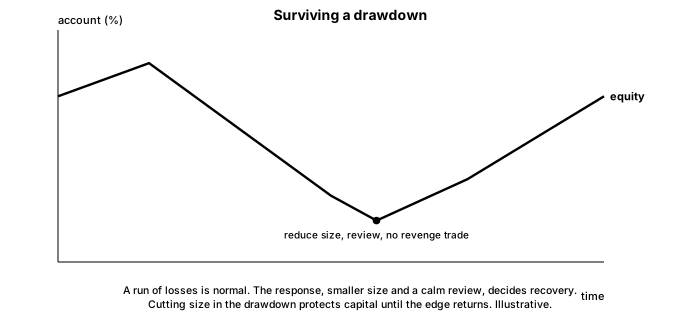
Everything in your gut during a drawdown pushes you toward the exact wrong response: bet bigger to win it back faster. You now know where that leads, through tilt and revenge trading, to ruin. The professional does the opposite, and it is worth stating as a rule: in a drawdown, you reduce size, you do not increase it.
The reason is both mathematical and psychological. Cutting your risk per trade slows the bleed while you are cold. Suppose you are in a drawdown and the losses keep coming. At your normal 1% risk, another ten losing trades would cost you about a further 10% of your account. Halve your risk to 0.5%, and the same ten losses cost only about 5%. You have bought yourself twice as much room to find your footing, and lowered the emotional temperature at the same time, because smaller losses are easier to take calmly. Trading smaller in a drawdown is how you stay in the game long enough for your edge to reassert itself.
Alongside smaller size comes honest review, using the journal. A drawdown is the time to ask, calmly, whether this is ordinary variance, which the numbers say it usually is, or whether something has genuinely changed: a leak has opened, or the market has shifted under a strategy that used to work. The journal answers that question with evidence instead of fear. If it is variance, you hold your process and wait. If it is a real problem, you find it and fix it, at reduced size, rather than betting more on a broken approach.
Protecting your mind, not just your money
A drawdown is as much an emotional test as a financial one, and the two feed each other. The strain of watching your account shrink is exactly the state, from the chapter on routine, in which self-control runs down and discipline gets harder, which is why drawdowns and tilt so often arrive together. So the psychological tools matter most here. Keep your loss limits firm, because a drawdown is when you most want to override them. Step away when the strain builds. Lean on the routine that steadies you. And hold on to the honest perspective that this has happened to every trader who ever lasted, that it is survivable precisely because you sized it to be, and that coming through it with your capital and your composure intact is itself a win.
What to carry forward
A drawdown is not a sign you are broken, it is the certain weather of a probabilistic game, and every lasting trader has been through many. The losses themselves stay small if you sized them right; the danger is the reaction, so the rule is to trade smaller in a drawdown, not bigger, which slows the bleed and cools the emotion, while the journal tells you honestly whether it is variance or a real leak. Guard your composure as carefully as your capital, because the two fail together.
If a losing streak is the test most traders expect, the next one is the danger they never see coming, because it wears the disguise of success. The next chapter is about the winning streak, and why a run of profits can be more dangerous than a run of losses.