Course contents
The hole a loss digs
A loss and a gain of the same percentage do not cancel out. A 50% loss needs a 100% gain just to break even, and the deeper the hole, the steeper the climb, which is why avoiding large losses matters more than catching large gains.
- Show the asymmetry of recovery with a worked table
- Define drawdown
- Explain why protecting capital from large losses is the first priority
Ask most people a simple question: if you lose 50% of your money, how much do you need to make to get back to where you started? The instant answer, the one that feels obviously correct, is 50%. It is also wrong, and the gap between that comfortable wrong answer and the real one is the reason careful traders fear large losses more than they chase large gains.
Watch what actually happens. Say you begin with 1,00,000 rupees and you lose half. You now have 50,000. To climb back to 1,00,000 from there, you do not need 50%. Fifty percent of 50,000 is only 25,000, which brings you to 75,000, still short. To get all the way back you have to turn 50,000 into 1,00,000, which is a gain of 100%. You have to double your money just to undo halving it. The loss and the recovery are not the same size, and they never are.
Why the two are not symmetric
The reason is simple once you see it. A percentage loss is taken on a larger number, your capital before the loss. The percentage gain that repairs it has to be earned on a smaller number, your capital after the loss. The hole is measured against what you had. The climb out is measured against the less you are left with. So the climb is always steeper than the fall that dug it.
There is a clean rule for the gain you need: it is the fraction you lost divided by the fraction you have left. Lose a quarter and you keep three quarters, so you need a quarter divided by three quarters, which is a third, about 33%. The bigger the loss, the faster that required gain runs away from you.
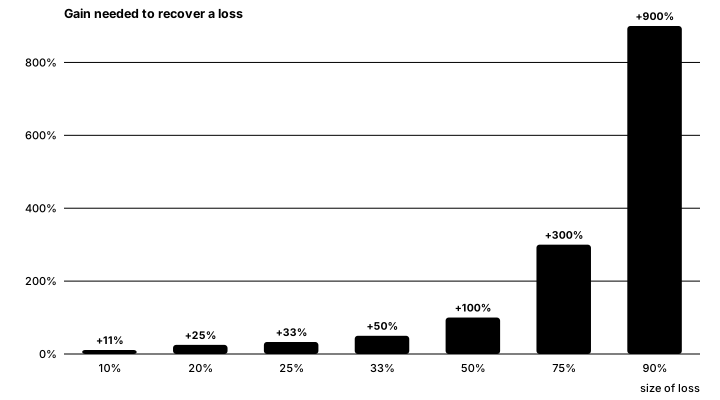
| Loss taken | Gain needed just to break even |
|---|---|
| 10% | 11% |
| 20% | 25% |
| 25% | 33% |
| 33% | 50% |
| 50% | 100% |
| 75% | 300% |
| 90% | 900% |
Notice how gentle the top of the table is and how violent the bottom becomes. A 10% loss needs a barely different 11% to recover. Losses in that range are the ordinary cost of trading and easily repaired. But the line bends upward fast. By a 50% loss you must double your money. By a 90% loss, the kind a single oversized, leveraged trade can inflict in a day, you need a 900% gain, a ten-fold return, just to see your original capital again. For most traders that is not a recovery plan. It is the end.
Drawdown, the number to watch
Traders have a word for how far you have fallen from your best. A drawdown is the drop from a peak in your account value to a later low, written as a percentage of that peak. If your account grows to 1,20,000 rupees and then falls to 84,000, you are in a 30% drawdown, whatever your starting point was.
Drawdown matters because it is measured from your high-water mark, the most you have ever had, which is the figure your confidence quietly anchors to. Losing 36,000 off a 1,20,000 peak stings more than the same 36,000 would have on the way up, and by the arithmetic you just saw, that 30% drawdown already needs about a 43% gain to erase. The number you brag about at the top is the number the market can take back the fastest.
Why this makes avoiding losses the first job
Put the two ideas together and a priority falls straight out of the arithmetic. Because deep losses are so much harder to undo than shallow ones, the single most valuable habit is not finding bigger winners. It is refusing to take losses large enough to cripple the recovery. A trader who never lets a loss pass, say, 20% of capital is always within a manageable 25% gain of breaking even. A trader who lets one position run to a 70% loss must more than triple what remains, and will probably chase that impossible gain into an even deeper hole.
Protecting your capital from large losses is not caution for its own sake. It is what keeps recovery arithmetically possible.
What to carry forward
A loss digs a hole that is steeper to climb out of than it was to fall into, because the recovery is earned on the smaller sum the loss left behind. Fifty percent lost needs a hundred percent gained. Ninety percent lost needs nine hundred. Drawdown is the name for how far you have fallen from your peak, and the asymmetry is why keeping every drawdown small is the first job of a trader, ahead of any hunt for gains.
But there is a second, quieter danger that even small, sensible losses carry when they arrive together. A string of ordinary losses, which is certain to come sooner or later, can still wipe out a trader who bets too much on each one. The next chapter is about exactly that: the risk of ruin, and why even a trader with a real edge can go broke.