Course contents
The danger hiding in success
A run of wins is more dangerous than it feels, because it breeds overconfidence, bigger size, and sloppiness right before the market turns. Staying level in success is as important as staying calm in loss.
- Explain why winning streaks lead to overconfidence and over-sizing
- Separate a genuine edge from a lucky run
- Give the discipline of holding size and rules steady through success
Every trader dreads a losing streak and braces for it. Almost no one braces for a winning streak, which is precisely why a run of wins is the more dangerous of the two. A losing streak hurts, so it keeps you cautious. A winning streak feels wonderful, so it drops your guard exactly when your money is most at risk, and it does its damage while you are congratulating yourself. The market's cruellest trick is to be generous right before it collects.
Why success lowers your guard
After a string of wins, three forces from earlier in the course quietly combine against you. Recency bias makes the recent run feel like the new normal, so you expect the next trade to win too. Overconfidence turns the luck of a good run into a belief in your own genius, so you trust your judgement over your rules. And greed, freed from the fear that a losing streak keeps alive, whispers that you should press your advantage while you have it. The result is predictable: you start sizing up, taking marginal trades you would normally skip, loosening the stops that feel unnecessary when everything is working. Success makes you sloppy, and the market eventually charges for sloppiness.
The trap is sharpest because a winning streak is often mostly luck, and luck does not know it is your turn. Recall from the chapter on the risk of ruin that streaks, in both directions, are the expected weather of a probabilistic game. A run of six wins is no more proof of permanent skill than a run of six losses is proof you have lost your touch. Both are mostly noise. The trader who mistakes a lucky streak for a new, higher level of ability is being set up by their own good fortune.
What sizing up actually does
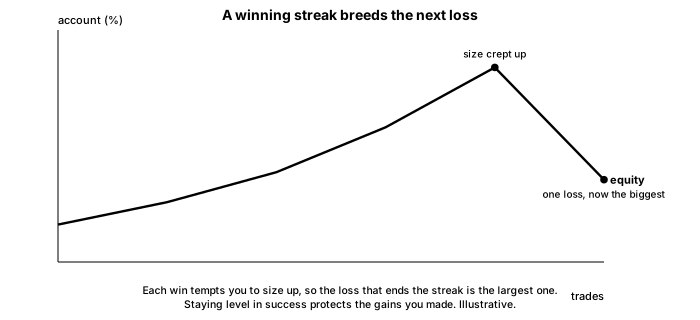
See why pressing a streak with bigger size is so dangerous. Suppose a lucky run hands you six wins, and at your normal size that is worth, say, plus 6R banked. Feeling invincible, you triple your position size, certain the streak will continue. Then the streak ends, as streaks do, and you take three ordinary losing trades, the kind you would have shrugged off before. At triple size, those three losses cost three times as much each, minus 9R in total. Your plus 6R streak is now a minus 3R month. You gave back everything the streak earned, and more, on just three normal losses, purely because you sized up at the top.
This is the winning streak's whole mechanism in one calculation. The gains from a streak are banked at your old, sensible size. The losses that follow it are taken at your new, inflated size. That asymmetry is how so many traders give back weeks of profit in a couple of days, and why the danger hides so well inside success.
Staying level
The discipline is the same one you practise in a drawdown, aimed in the opposite direction: keep your size and your rules steady, whatever your recent results. A winning streak does not earn you the right to bet bigger, any more than a losing streak forces you to. You change your size deliberately, based on a measured, long-run edge shown by your journal, never on the emotional high of a good run. If your process genuinely improves over hundreds of trades, size up slowly and on purpose. If you are simply hot, enjoy it, bank it, and change nothing.
The professional's response to a great run is almost boring: note it, stay humble, remember it is partly luck, and trade the next setup exactly as the plan says, at exactly the size the plan allows. Staying level in success is less natural than staying calm in loss, and just as important, because the account you protect from your own overconfidence is the same account a drawdown will later test.
What to carry forward
A winning streak is the danger you never brace for, because it feels like skill while it is mostly luck, and it tempts you, through recency bias, overconfidence, and greed, to size up and loosen your rules exactly when the turn is coming. The arithmetic is unforgiving: bank a streak at your old size, then take three normal losses at triple size, and a plus 6R run becomes a minus 3R one. The discipline is to stay level, holding size and rules steady through success and changing them only deliberately from a measured edge.
That completes Part 4 and the habits of a disciplined trader: judging process over outcome, keeping a journal, protecting your state, waiting patiently, and staying steady through both drawdowns and winning streaks. Part 5 steps back to the honest, big-picture questions, beginning with what trading can and cannot realistically do for you.