Course contents
The habit that actually makes you better
Writing down every trade, the reason, the size, the result, and how you felt, and reviewing it, is the feedback loop that turns experience into skill. Without it, you repeat the same mistakes blindly.
- Explain what to record in a trading journal, including the emotional state
- Show how regular review reveals patterns and leaks
- Make the journal the engine of improvement
People say experience is the best teacher, but in trading that is only half true. Ten years of trading without keeping records is not ten years of experience. It is one year of the same mistakes, repeated ten times, because nothing was written down long enough to be noticed. Experience only teaches when you can look back at what you actually did, honestly and in detail, and see the pattern. The tool that makes that possible is a trading journal, and it is the closest thing to a shared secret that consistent traders have.
What goes in the journal
A trading journal is a record of every trade you take, written at the time, before the outcome can colour your memory of it. Memory is a liar in trading: after a win you will remember being confident, after a loss you will remember having doubts, and neither is reliable. So you write it down as it happens. For each trade, record:
- The setup: what made this a trade you were allowed to take, in the words of your plan.
- The numbers: your entry, your stop, your target, your position size, and the reward-to-risk.
- The outcome: where you exited, and the result in rupees and in R.
- The behaviour: did you follow the plan or break it, and exactly how. This is the most important line and the one people skip.
- The feeling: what you felt entering, holding, and exiting. Calm, fearful, greedy, bored, on tilt.
That last item, the emotional state, is what turns a plain trade log into a psychology journal. The whole of Part 3 was about emotions distorting decisions, and the only way to catch your own patterns is to record how you felt and then see, later, which feelings led to which mistakes.
The review is where the value is
Recording is half the habit. Reviewing is the half that makes you better. Once a week, and again over a month, you sit with the journal and read it as an outsider. Patterns you could never feel in the moment become obvious on the page. You might find that your worst losses all came on tired Friday afternoons, or that your revenge trades cluster right after a stopped-out loss, or that the trades you marked "greedy" underperformed the ones you marked "calm". These are your leaks, the specific, repeated ways you lose money, and you cannot plug a leak you cannot see.
The journal also tells you the truth about your edge. From the recorded results you can compute your real win rate, your average win and loss, your reward-to-risk, and your expectancy in R, the numbers from Parts 1 and 2 that most traders only guess at. Guessing, you might believe you are a good trader having a rough patch. The journal might show you are a decent trader with one expensive leak, or that your winners are being cut too early exactly as the disposition effect predicts. It replaces a comfortable story with a measured fact, and you can only fix what you measure.
How the journal changes behaviour
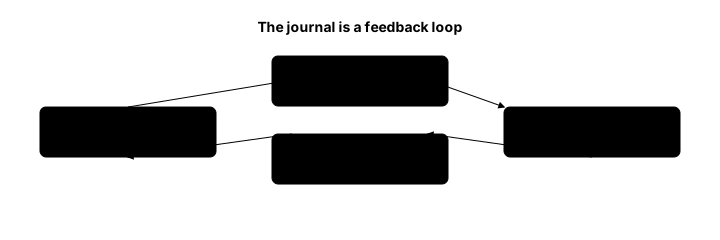
There is a quieter benefit that shows up before any review. Knowing you will have to write down, in your own words, that you cancelled a stop or chased a trade or sized up on tilt makes you slightly less likely to do it. The journal is a witness, and the presence of a witness improves behaviour. Over time the loop compounds: you record honestly, you review, you find a leak, you write a rule to plug it, you follow the rule, and you record whether it worked. That loop, not any indicator or tip, is what actually turns a beginner into a competent trader. It is slow, unglamorous, and it works.
What to carry forward
A trading journal is the habit that makes experience actually teach: record every trade as it happens, including your behaviour and your emotional state, then review it weekly and monthly to find your leaks and measure your true edge. The review replaces a flattering story with a fact, and the mere act of recording makes you behave better in the moment. It is the engine of improvement, and it runs on honesty.
The journal captures the quality of your decisions, but the quality of your decisions depends on the state you are in when you make them. The next chapter is about that state, and why your sleep, your screen, and your surroundings are risk management too.