Course contents
Deciding where you are wrong, in advance
A stop-loss is the price at which you admit the trade is wrong and get out. Set before you enter and honoured without argument, it is what caps a loss at the size you chose.
- Define a stop-loss and explain why it is set before entry
- Explain sensible placement at a level that proves the idea wrong, not an arbitrary or too-tight point
- Discuss honouring stops and the danger of moving them
The worst possible moment to decide whether to sell a losing trade is while you are losing. Your money is on the line, your pulse is up, and every instinct is telling you it will come back if you just wait a little longer. So you do not decide then. You decide before you enter, while you are calm and honest, at what price you would admit the trade has failed. That pre-decided exit is a stop-loss, and it is the other half of the sizing you just learned.
What a stop-loss is
A stop-loss is a price, chosen before you enter a trade, at which you will exit to cap your loss. For a trade where you bought expecting a rise, it sits below your entry. If the price falls to it, you sell and take the small, known loss. It is the line that says: below here, I was wrong, and being wrong is allowed, but paying more than I planned for it is not.
The stop is what made the last chapter work. Your position size came from the distance between your entry and your stop. Without a stop there is no stop distance, no defined risk, and no real position sizing, only a hope that you will find the courage to sell at the right time, which under pressure you will not.
Where the stop goes
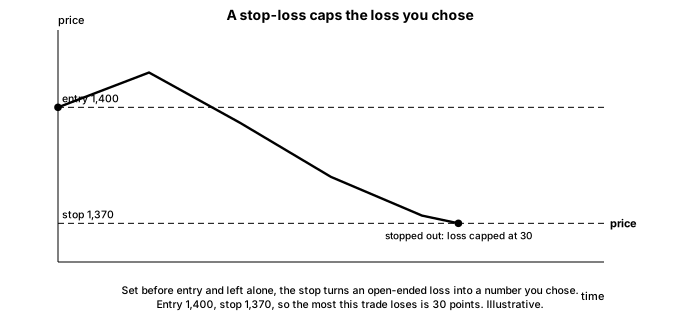
A stop belongs at a level that proves your reason for the trade wrong, not at an arbitrary round number and not so close that ordinary noise trips it. Suppose you bought Reliance at 1,400 because it had been holding a support level near 1,375, a floor buyers kept defending. The logical stop sits just below that floor, say 1,370, because if the price breaks the level you were watching, the very reason you bought has failed. That is a stop with a meaning.
Contrast two mistakes. Place the stop too tight, at 1,395, only 5 rupees away, and the normal wobble of a single day will stop you out of a trade that was never actually wrong, again and again, each time costing you the loss and the trading costs. Place no stop at all, and a slide to 1,250 becomes a 150-rupee loss on your 66 shares, nearly 10,000 rupees, five times the 2,000 you had decided to risk. A stop has to be far enough to give the trade room to breathe, and close enough to keep the loss small. The right place is the level that, if broken, means your idea was wrong, and your position size is then built around that distance, not the other way round.
Set it as an order, and leave it alone
A stop can live in your head or as a resting order with the exchange. For most people, an actual stop-loss order, placed the moment you enter, is far safer than a mental one, because a mental stop asks you to act decisively at the exact moment you are least able to. You met the order types for this in Stock Market Basics; a resting stop order triggers automatically when the price is reached.
Then comes the hardest rule in trading, and the most important one in this chapter: once set, you honour the stop. You do not slide it further away as the price approaches, telling yourself the trade needs more room. Moving a stop to avoid a loss is how a 2,000 rupee loss becomes a 20,000 rupee loss. The whole value of the stop is that a calmer, wiser version of you set it, and the panicking version does not get to overrule it. Moving a stop closer to protect a profit on a winning trade is fine. Moving it away to dodge a loss is the cardinal sin.
A stop is a discipline, not a guarantee
Be clear about what a stop can and cannot do. It caps the loss you take by decision, but it does not guarantee the exact price. If the market gaps, opening far below your stop after bad news overnight, your exit fills at the next available price, which can be worse than your stop. This gap between your stop price and your actual fill is called slippage. It is real, it is why overnight positions in leveraged instruments are dangerous, and it is one more reason to keep position size small. The stop is your discipline, not a force field.
What to carry forward
A stop-loss is a decision made in advance, while you are calm, about the price at which you will admit you were wrong. It belongs at the level that breaks your reason for the trade, and it must be honoured, because moving it away from the price is how small losses become ruinous ones. Together, position size and the stop give you a trade with a known, capped downside before you ever enter.
But a capped downside is only half of whether a trade is worth taking. The other half is what you stand to gain against what you are risking. The next chapter weighs the two, the reward against the risk, and shows how that ratio decides which trades are worth taking at all.