Course contents
Single-candle patterns
A few single candles, the doji, hammer, and shooting star, hint at indecision or a possible turn, but only ever as hints that need a prior trend, a level, and confirmation.
- Read the doji, hammer, and shooting star
- Explain what each suggests
- Understand that a single candle is a hint, not a signal on its own
Some individual candles have earned names because their shape hints at hesitation or a possible turn. Before the names, the honest part: a single candle is a hint, never a signal on its own. It matters only in context, after a clear trend and at a level that means something. Keep that in mind as you learn the three worth knowing.
Three candles worth knowing
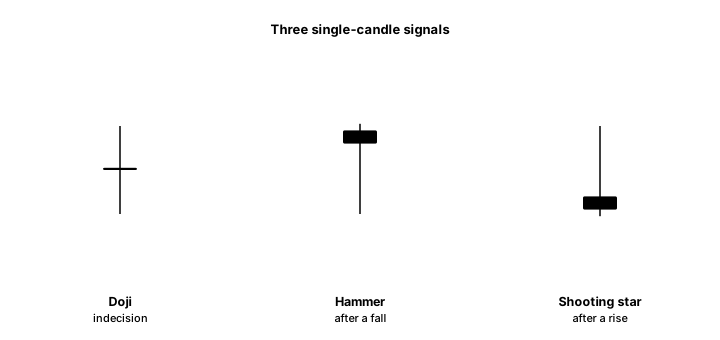
A doji has an open and close that are almost equal, so it has a tiny body or none at all, usually with wicks on both sides. It shows indecision, a period where buyers and sellers fought to a draw. After a strong trend, a doji hints that the trend's fuel may be running low.
A hammer has a small body near the top of its range and a long lower wick, with little or no upper wick, and it appears after a downtrend. Sellers drove price down during the period, but buyers slammed it back up by the close, rejecting the lower prices. It hints at a possible bottom.
A shooting star is the mirror, a small body near the bottom of its range with a long upper wick, appearing after an uptrend. Buyers pushed price up, but sellers knocked it back down by the close. It hints at a possible top.
One more, briefly: a marubozu is a candle with a full body and almost no wicks, a one-sided period where one side dominated from open to close, a sign of strong conviction.
The rule that makes them useful
A single candle earns meaning only with context. A hammer means something after a clear downtrend, sitting at a support level, and ideally confirmed by the next candle closing higher. The same hammer in the middle of a choppy, trendless range means nothing. The three conditions to look for are a prior trend for the candle to reverse, a level for it to happen at, and confirmation from what comes next.
What to carry forward
A handful of single candles carry names because their shapes hint at a shift: the doji at indecision, the hammer at buyers rejecting lower prices after a fall, the shooting star at sellers rejecting higher prices after a rise, and the marubozu at one-sided conviction. But every one of them is only a hint, and it earns weight solely from context, a prior trend, a level, and confirmation from the next candle. On its own, a single candle tells you almost nothing.
A few candles together tell a clearer story than any one, because they show a shift over time. The next chapter covers those multi-candle patterns.