Course contents
Multi-candle patterns
Two or three candles together, like engulfing patterns and stars, show momentum shifting more clearly than a single candle, but still only as hints that need a prior trend, a level, and ideally confirmation.
- Read bullish and bearish engulfing, harami, and the morning and evening star
- Explain the momentum shift each shows
- Keep context central and prefer a few reliable patterns
A single candle is one moment's story. Two or three candles together tell a clearer one, because they show the balance between buyers and sellers shifting over time rather than in a single period. That makes them more reliable than lone candles, though the same honest rule about context still holds.
The patterns worth knowing
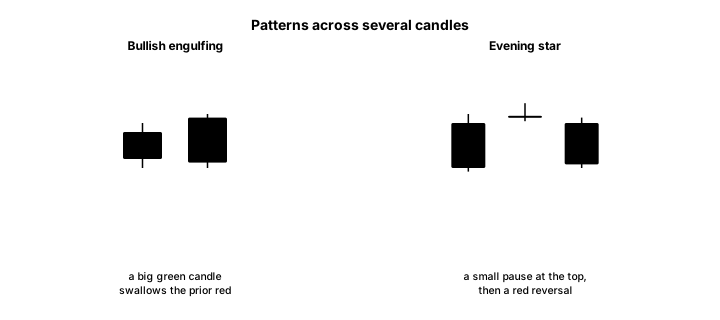
A bullish engulfing appears after a downtrend: a down candle, then a larger up candle whose body completely covers, or engulfs, the previous one. Buyers did not just nudge price up, they overwhelmed the prior period's sellers, a clear shift of momentum upward.
A bearish engulfing is the mirror, after an uptrend: an up candle swallowed by a larger down candle, as sellers take control.
A harami is almost the opposite of an engulfing: a large candle followed by a small candle that sits inside its body. It shows momentum suddenly pausing, the strong move giving way to hesitation, and it often warns that a trend is losing steam.
A morning star is a three-candle bottoming pattern: a large down candle, then a small candle that stalls (the star), then a large up candle that closes well back into the first. It paints a turn from selling, through indecision, to buying. The evening star is its mirror at a top.
Why several candles beat one
These patterns are stronger than single candles because they capture a shift across several periods, which is less likely to be random noise. An engulfing candle shows buyers decisively overpowering the sellers who were in control a period ago. But stronger is not the same as certain, and the context rule from the last chapter still applies: a pattern means most when it appears after a clear trend, at a meaningful level, and even better when the next candle confirms it.
What to carry forward
Two or three candles together read momentum more clearly than one, because they show the balance shifting over time. A bullish or bearish engulfing shows one side decisively overpowering the other, a harami shows a strong move stalling into hesitation, and a morning or evening star traces a turn through indecision. All of them are more reliable than single candles yet still only hints, earning their weight from a prior trend, a level, and confirmation. Master a few rather than collecting many.
Beyond a few candles, price traces larger shapes over weeks that mark where trends turn. The next chapter covers those reversal patterns.