Course contents
Moving averages
A moving average smooths price into a line that shows trend direction. SMA weights all periods equally, EMA favours recent ones. Crossovers are simple lagging signals, and averages whipsaw in ranges.
- Define simple and exponential moving averages
- Use a moving average to read trend direction
- Explain a crossover and its lag
Price is jagged and hard to read directly. A moving average smooths it into a single flowing line that shows the trend's direction at a glance. It is the most useful and most honest indicator there is, and the foundation of many others.
What a moving average is
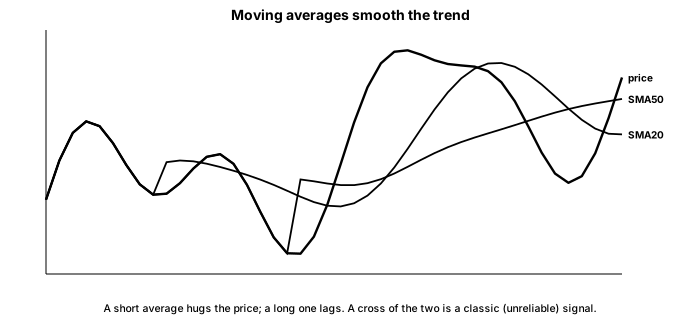
A moving average is the average of the closing price over the last set number of periods, recalculated each period so the line moves along with price. A twenty-day moving average is simply the average of the last twenty closes, updated each day. By averaging, it cancels out the day-to-day noise and leaves the underlying direction.
There are two common kinds. A simple moving average, or SMA, weights every period in the window equally. An exponential moving average, or EMA, gives more weight to the most recent prices, so it reacts faster to a change but is a little choppier. Neither is better in the abstract: the EMA is quicker and noisier, the SMA smoother and slower.
Reading the trend
The moving average reads the trend directly. When price is above a rising average, the trend is up. When price is below a falling average, the trend is down. The slope of the line is the direction. Shorter averages, like the twenty, hug price closely and show the near-term trend, while longer ones, like the fifty or the two hundred, show the bigger trend and move slowly. The two-hundred-day average in particular is watched by almost everyone as a line between a long-term uptrend and downtrend.
Crossovers
Because a short average reacts faster than a long one, the two cross when momentum shifts. A shorter average crossing above a longer one is a bullish signal, and crossing below is bearish. These crossovers are simple and honest, but they lag: by the time the lines cross, the move has already been underway for a while. That lag is the price of the smoothing.
What to carry forward
A moving average turns jagged price into a smooth line whose slope is the trend: above a rising average is up, below a falling one is down. The simple average weights all periods equally while the exponential one leans on recent prices to react faster, and neither is inherently better. Crossovers of a short and long average give a simple signal, but one that lags, and in trendless markets averages whipsaw. They are best used as honest trend context rather than a standalone system.
Averages show direction. The next chapter adds an indicator for the strength of a move: RSI.