Course contents
Continuation patterns
Flags, pennants, and triangles are pauses within a trend that usually resolve in the trend's direction on a volume-backed breakout. Usually is not always, so trade the breakout, not the label.
- Read flags, pennants, and triangles
- Explain the pause-and-continue idea
- Understand that continuation is likely, not guaranteed
Not every pattern is a reversal. Some are pauses, where a trend catches its breath before, more often than not, continuing in the same direction. The common ones are flags, pennants, and triangles, and they share a single idea: a strong move, a rest, and a resumption.
The patterns
A flag appears after a sharp move, called the pole. Price then drifts sideways or slightly against the trend in a small, tidy range, the flag, before breaking out in the original direction and resuming the move. A rally, a brief pause, then more rally.
A pennant is much the same, except the pause takes the shape of a small converging triangle rather than a tidy rectangle. Same story, slightly different shape.
Triangles are consolidations where price squeezes into a narrowing range as the highs and lows converge. An ascending triangle has a flat top and rising lows, leaning bullish. A descending triangle has a flat bottom and falling highs, leaning bearish. A symmetrical triangle narrows from both sides and is neutral until it breaks. In every case, the breakout direction is what decides the trade.
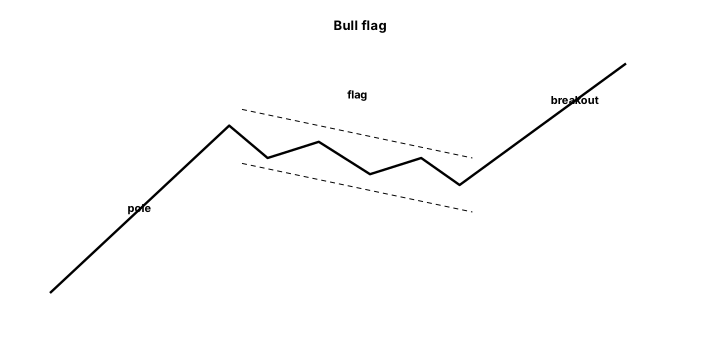
The pause-and-continue idea
These patterns form because a strong trend needs to rest. After a sharp move, some traders take profits and new ones wait to join, and price consolidates for a while. Volume typically dries up during the pause, then surges on the breakout, exactly the confirmation the volume and breakout chapters called for. The height of the pole gives a rough target: add it to the breakout point for an approximate idea of how far the resumed move might run.
What to carry forward
Flags, pennants, and triangles are rests within a trend, a sharp move followed by a tidy consolidation on fading volume, then a breakout that usually resumes the original direction. The pole gives a rough target, and the volume surge on the break is the confirmation to look for. But usually is not always: the pattern is only a setup, and the breakout direction, not the reassuring name, is what you actually trade, always with a stop.
Sometimes price does not consolidate or reverse smoothly at all. It jumps, leaving a gap, and the next chapter reads what those jumps mean.