Course contents
Gaps
A gap is a jump leaving empty space on the chart. Common gaps are minor and often fill, breakaway gaps break levels on volume and can start trends, and exhaustion gaps near a move's end can precede reversals.
- Define a gap
- Distinguish common, breakaway, and exhaustion gaps
- Explain gap fills and correct the myth that all gaps fill
Price does not always move smoothly from one candle to the next. Sometimes it jumps, opening far from where the last candle closed and leaving an empty space on the chart with no trading inside it. That space is a gap, and different gaps carry very different meanings.
What a gap is
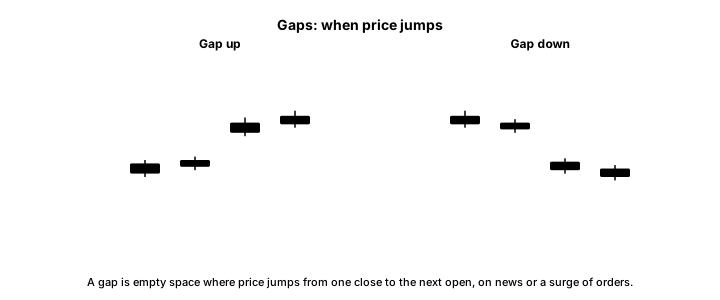
A gap is a jump between one candle's close and the next candle's open, so that a band of prices has no trading in it. Gaps are common in individual stocks, because the market is shut overnight and news, results, or global events can move a stock a long way before it next opens. Indices gap too. A gap is the market repricing a stock all at once rather than trading its way there.
Three kinds of gap
A common gap is a small jump within a range, on no particular news. It carries little meaning and often fills quickly, meaning price soon trades back across the empty space to cover it.
A breakaway gap jumps price out of a range or a pattern, on heavy volume, and often marks the start of a new trend. It is significant, and it may not fill for a long time, if at all.
An exhaustion gap appears near the end of a big move, a last euphoric jump up or panic jump down, and is often followed by a reversal as the move runs out of participants.
Volume and context tell you which is which. A gap on huge volume that breaks a level is likely a breakaway. A small gap in a quiet range is likely a common gap. A gap after a long, stretched run may be exhaustion.
What to carry forward
A gap is price jumping rather than trading its way from one level to the next, leaving an untraded space on the chart. Common gaps are minor and often fill, breakaway gaps clear a level on heavy volume and can launch a trend, and exhaustion gaps near the end of a stretched move can warn of a reversal. Volume and context tell the three apart, and the old rule that every gap fills is simply not true.
You have now met candles, multi-candle patterns, reversal and continuation shapes, and gaps. The next chapter is the most important in this part, because it explains why none of them means much on its own.