Course contents
What moves an option's price
Three forces move an option's premium: the underlying's price, the passage of time, and expected volatility. Only the first is direction, which is why time and volatility can beat a correct call.
- Name the three forces that move a premium in plain words
- Connect each force to the premium
- Understand that the Greeks are names for these forces
You now know that a premium is intrinsic value plus time value, and that it moves before expiry. The natural question is what makes it move. The answer is three forces, and once you can name them in plain words, the Greek letters of the next chapters turn out to be nothing more than labels for how hard each force pushes.
Three forces on a premium
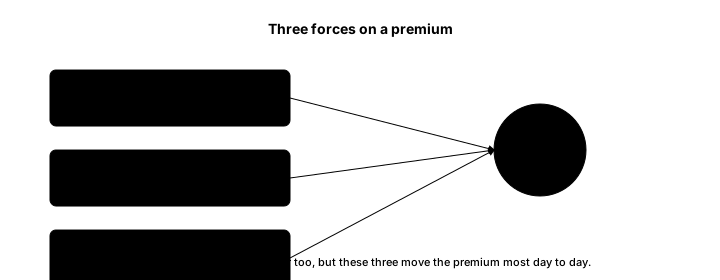
The underlying's price. When the stock moves, the premium moves with it. A call gains as the stock rises, a put gains as it falls. This is the obvious force, the one a beginner already expects, and the next chapter, on delta, measures it.
Time. Every day that passes drains a little time value, the decay of the last part. This force pushes only one way, downward, and only ever against the buyer. The chapter on theta puts a number on it.
Volatility. This is how much movement the market expects from the underlying over the option's life. More expected movement means more hope, and more hope means a fatter premium. Less expected movement means a thinner one. The chapter on vega measures this, and it is the force beginners most often overlook.
There are a couple more forces, such as the level of interest rates, but they are minor for a beginner trading short-dated options, and one of them, the way the price force itself speeds up, gets its own gentle treatment later. Three forces are enough to hold in your head: price, time, and expected volatility.
What this tells you
An option premium is really a price on movement, set by where the underlying is now, how much time is left for it to move, and how much movement the market expects. Each Greek you are about to meet simply measures how sensitive the premium is to one of these forces.
The point worth pausing on is this. Two of the three forces, time and volatility, have nothing to do with the direction of the stock. That is the plain reason, from an earlier chapter, that you can be right on direction and still lose. Naming the forces takes the mystery out of it.
What to carry forward
An option's premium is pushed by three forces: the price of the underlying, the passing of time, and the market's expected volatility. The first is direction, and the other two are not, which is the plain reason a right call can still lose money. The Greeks that follow are just measures of how strongly each force moves a given option, and they are meant to be felt as intuition rather than ground out as sums.
The most intuitive of them comes first. The next chapter is about delta, how much an option follows the stock.