Course contents
Gamma and the rest
Gamma is how fast delta changes, highest at-the-money and near expiry. Rho is minor for a beginner. The practical goal is to feel the three main forces, delta, theta, and vega, not to compute them.
- Explain gamma in plain terms
- Note the minor Greek, rho, briefly
- Summarise which Greeks matter most to a beginner
Two pieces remain to round out a beginner's picture of the Greeks. The main one is gamma, which describes how delta itself changes, and after it a couple of minor characters that a beginner can safely keep in the background. As always, aim for the intuition, not the mathematics.
Gamma: how fast delta changes
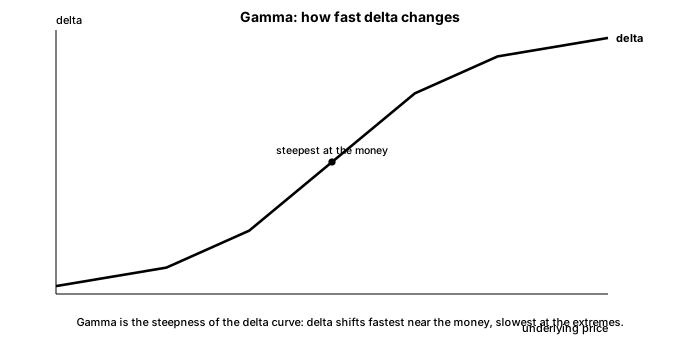
Delta, from an earlier chapter, is not a fixed number. As the underlying moves, delta moves. Gamma measures how fast delta changes as the underlying moves. If delta is the option's speed relative to the stock, gamma is its acceleration. A high gamma means delta shifts quickly as the stock moves, and a low gamma means delta barely budges.
Gamma is largest for at-the-money options, and it grows as expiry nears. That combination, at-the-money and close to expiry, is where a small move in the stock flips an option's delta the most. It is why a near-expiry at-the-money option can lurch from barely moving to moving almost like the stock within a single session. Those options feel wild precisely because their gamma is high.
For intuition, gamma explains why delta is a moving target, and why a position near its strike close to expiry can change character fast. For a buyer, gamma is a friend when a move is underway, because delta grows in your favour and the option accelerates. For a seller, gamma is a danger, because delta can swing against them quickly. You do not need to compute it. You need to know that near the strike and near expiry, things move fast.
Rho, and knowing what to ignore
The remaining Greek worth naming is rho, the sensitivity of an option's premium to interest rates. For a beginner trading short-dated options, rho is small enough to set aside. It is real, but it rarely drives a beginner's outcome, so note that it exists and move on.
Which Greeks a beginner should feel
Here is the whole set, kept in proportion. Feel three forces: delta, whether your option is sensitive to the move; theta, whether you are bleeding time; and vega, whether you overpaid for volatility. Gamma explains why delta itself shifts, sharpest near the strike and expiry. Rho is minor. You are not meant to calculate any of them. You are meant to ask three plain questions before and during a trade: will it react to the move, how fast is time working against me, and did I pay too much for expected movement.
What to carry forward
Gamma describes how quickly delta changes, and it is largest at-the-money and near expiry, which is why options close to their strike in their final days move so sharply and can turn on a buyer or seller fast. Rho, the sensitivity to interest rates, is minor for a beginner and can be set aside. The sane way to hold the whole set is as three questions rather than five formulae: is my option sensitive to the move, is time working against me, and did I overpay for volatility. Delta, theta, and vega answer those, and gamma explains why delta keeps shifting.
That completes the forces that move an option's price. The final part of the course puts everything to work in the four basic positions and in trading safely, and it begins with the simplest bullish trade, the long call.