Course contents
What is an option
An option is the right, not the duty, to buy or sell an underlying at a fixed strike by a fixed expiry, bought for a premium that is the buyer's most to lose.
- Explain the right-without-obligation idea with an everyday analogy
- Name the four pieces every option has: premium, strike, expiry, underlying
- Understand that a buyer's maximum loss is the premium
Say a wedding in your family is three months away, and you will need to buy gold for it. Gold today costs a certain amount, and you are worried the price will climb before the date. So you make a small arrangement with a jeweller. You pay a small token now, and in return the jeweller gives you the right to buy a fixed quantity of gold at today's price any time in the next three months. You are not promising to buy. You are buying the choice to buy.
Play out the two endings. If gold rises, you use your locked price, buy at the old rate, and keep the difference. If gold falls, or the wedding plans change, you simply walk away. You lose only the small token you paid, and nothing more. That small, one-sided arrangement is exactly what an option is.
A right, not an obligation
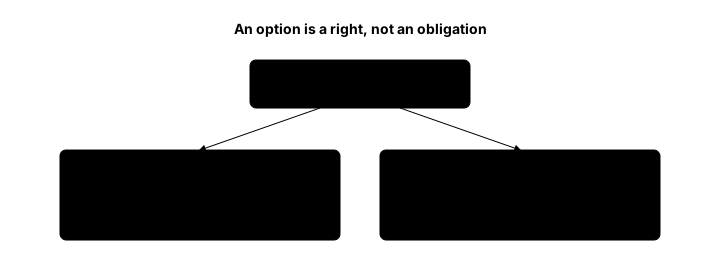
An option is a contract that gives you the right, but not the obligation, to buy or sell something at a price fixed today, on or before a future date that is also fixed today. Read that once more, because the two words that carry the whole meaning are not the obligation. You hold a choice. You are never forced to go through with it.
Most agreements are not like this. Sign to buy a car and you must pay for it or lose your deposit and face trouble. An option flips that around. You pay a small amount up front, and in exchange you get to decide later whether the deal is worth doing. If it is, you act. If it is not, you let the option lapse, and the only money gone is that small up-front payment.
That up-front payment is the premium, the price of holding the right, and for a buyer it is the most that can ever be lost. The locked price is the strike. The deadline is the expiry, after which the right disappears. And the thing the option is written on, the gold in our story, is the underlying. Every option you will ever meet is built from these four: a premium you pay, a strike you lock, an expiry you race against, and an underlying it all refers to.
Options come in exactly two types, and every strategy ever built uses only these two. A call is the right to buy the underlying at the strike. A put is the right to sell it at the strike. The next chapters take each apart, but hold the simple picture now: a call to buy, a put to sell.
In the Indian market you will see these two types written as short labels on the option's name: CE for a call and PE for a put. You will learn to read a full option name in a later chapter, but even now you can spot the type at a glance.
What to carry forward
An option is the right, not the obligation, to buy or sell an underlying at a fixed strike by a fixed expiry, bought for a premium that is the buyer's most to lose. There are only two types, the call to buy and the put to sell, and every option is framed by four things: premium, strike, expiry, and underlying. Keep the gold-token picture close, because almost every confusing thing about options becomes clear when you ask the plain question behind it: am I paying a small amount today for the choice to act later, free to walk away? If so, you are looking at an option.
A fair question follows. Why would anyone pay for a choice they might never use? The next chapter gives the two honest reasons.