Course contents
The option chain
The option chain lists every strike for one underlying and expiry, calls on one side and puts on the other. Find the at-the-money row and moneyness and premiums fall into place.
- Read the layout of an option chain
- Locate strike, premium, open interest, and volume
- Find the at-the-money row and read moneyness around it
Open an option chain for the first time and it looks impossible: dozens of strike prices, two sides of numbers, premiums, and more figures besides, all updating at once. It is not impossible. It is highly organised, and once you know the layout you can read the important parts in seconds.
What the chain is
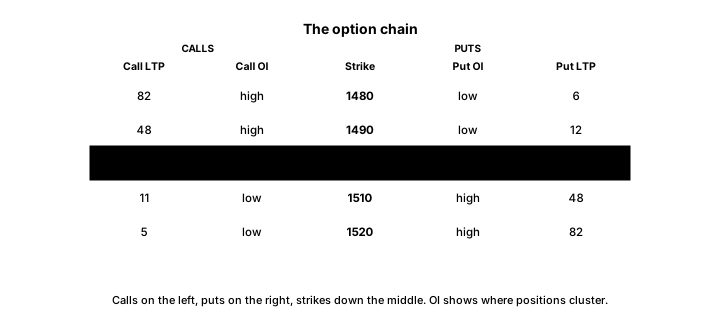
An option chain is a table that lists, for one underlying and one expiry, every available strike, with the call information on one side and the put information on the other. It is the whole menu of options on that stock or index for that expiry, in a single view.
The layout is consistent. The strike prices run down the middle column, in ascending order. To one side sit the calls, and to the other sit the puts. Each row is a single strike, showing its call on one side and its put on the other. So a single row, say the 1,520 strike, tells you about both the 1,520 call and the 1,520 put at a glance.
What each side shows
For each option, the chain shows its premium, usually the last traded price, and often the bid and ask you met in the first course. It also shows two activity figures. Volume is the number of contracts traded today. Open interest, or OI, is the number of contracts currently outstanding at that strike, a gauge of how many positions are parked there. High volume and open interest usually mean a liquid strike with a tight spread, which is easier and cheaper to trade.
Reading it around the price
The quickest way in is to find the current price of the underlying, then look at the strike nearest it: that is the at-the-money row. From there, moneyness falls into place using the mirror from the last chapter. Below the current price, calls are in-the-money and puts are out. Above it, calls are out and puts are in. Premiums follow: a call gets cheaper as you climb to higher, further out-of-the-money strikes, and dearer as you drop to in-the-money ones. The chain is really just intrinsic value and time value laid out across every strike.
What to carry forward
The option chain is the full menu of options on one underlying for one expiry, calls to one side, puts to the other, strikes in ascending order down the middle. Find the current price, mark the at-the-money strike, and the whole grid resolves into the moneyness and value ideas from the last two chapters. Volume and open interest tell you how liquid and active a strike is, and are worth respecting as liquidity signals rather than trusting as forecasts.
The chain quietly hides one more thing you must understand before risking money: the numbers are per share, but you cannot trade a single share's worth. The next chapter is about lots, and the real rupees at stake.