Course contents
Selling options
Selling an option collects the premium but takes on an obligation, a capped reward against large or unlimited risk. Time decay favours the seller, but one big move can erase many premiums. Beginners should sell only defined-risk forms, if at all.
- Explain the short call and short put, their payoff and premium income
- Explain the asymmetric risk and the margin honestly
- State clearly why a beginner sells only with defined risk, if at all
Every position so far has put you on the buyer's side, paying a premium for a right with your risk capped. This chapter crosses to the other side: selling options, also called writing them. It is where the premium income comes from, and it is where beginners are most often, and most badly, hurt. Approach it with more caution than anything else in this course.
Selling a call, selling a put
When you sell an option you receive the premium up front and take on an obligation in return, the mirror of the buyer from an earlier chapter.
Sell a call and you collect the premium, but you are obliged to deliver or settle if the call finishes in-the-money. If it expires out-of-the-money, you keep the premium as profit. Your reward is capped at that premium, and your risk has no natural ceiling, because the stock can rise without limit. A naked short call is the most dangerous of the basic positions.
Sell a put and you again collect the premium, but you are obliged to buy at the strike if the put finishes in-the-money. Your reward is capped at the premium, and your risk is large, running down to the strike less the premium as the stock falls toward zero, though at least it is bounded, unlike the short call.
The shape, and why anyone sells
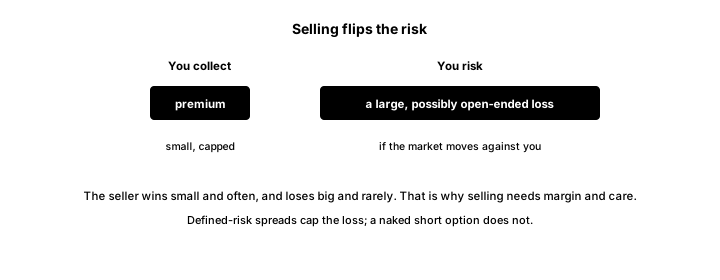
The seller's payoff is the buyer's turned upside down: a capped reward, the premium, sitting above a large or unlimited potential loss. Time is on the seller's side, since the theta that bleeds the buyer is income to the seller, and most options do expire out-of-the-money, so a seller wins often.
That is the temptation, and here is the honest warning that must sit beside it. Winning often is not the same as being safe. A seller collects small premiums again and again, and then a single large adverse move hands them a loss that can wipe out many months of those premiums at once. This is the asymmetry from the buyer-and-seller chapter, now sharp and concrete.
Naked risk, defined risk, and margin
Selling an option with nothing to protect you is called naked selling, and it carries that large or unlimited risk in full. Selling with protection in place makes the risk defined. The two forms a beginner might reasonably use are a covered call, where you sell a call against shares you already own, so the shares cover the obligation and cap the risk, and a cash-secured put, where you hold enough cash to buy the shares if you are assigned, so you are simply being paid to perhaps buy a stock you wanted anyway.
Because a seller's exposure is large, the exchange requires you to post margin, collateral set aside against that exposure. If the position moves against you, that margin requirement can rise and money can be demanded from you, the margin call from the first course. Selling ties up real capital and puts it at real risk.
What to carry forward
Selling options reverses the buyer's deal: you take the premium and the obligation, with a capped reward and a large or unlimited risk, while time decay works in your favour and most options expire worthless. That combination of frequent small wins and rare large losses is exactly why selling feels safe and is not, and why naked selling has no place in a beginner's account. If you sell, sell defined-risk, respect the margin, and size for the worst case. The honest asymmetry from early in the course is the thing to carry: the seller is paid precisely for bearing a risk the buyer shed.
You have now seen all four basic positions. The next chapter gathers the options-specific ways traders lose, so you can avoid them.