Course contents
Intrinsic and time value
Every premium splits into two parts: intrinsic value, the real settle-now worth, and time value, the price of hope. Time value melts to zero by expiry.
- Define intrinsic value and time value
- Split a real premium into its two parts
- Understand why time value exists and why it decays
Put two call options on the same stock, expiring on the same day, side by side. One costs a premium of thirty-five rupees, the other only twelve. Same stock, same expiry, wildly different prices. The reason is that a premium is never a single lump. It is made of two parts, and once you can separate them, most of what puzzles beginners about option prices falls away.
Intrinsic value: the real worth right now
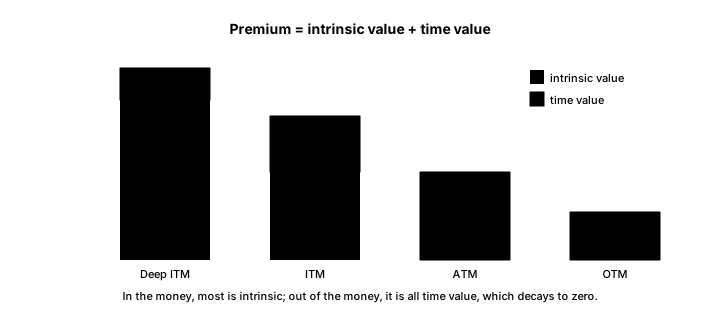
Intrinsic value is what an option would be worth if you settled it this very instant. For a call, the right to buy at the strike, that is how far the stock sits above the strike. For a put, the right to sell at the strike, it is how far the stock sits below the strike. If exercising right now would gain you nothing, the intrinsic value is simply zero, because you would never choose to exercise at a loss. Intrinsic value is never negative.
With Infosys at 1,500, a call with a strike of 1,480 has an intrinsic value of twenty rupees, because the right to buy at 1,480 when the stock is 1,500 is worth twenty rupees this second. A call with a strike of 1,520 has zero intrinsic value, because a right to buy at 1,520 is useless while the stock trades at 1,500.
Time value: the price of hope
If intrinsic value is the settle-now worth, time value is everything else in the premium. It is the extra amount buyers are willing to pay for the chance that the option gains worth before expiry. Time value exists because there is still time on the clock: the stock might move favourably, and that possibility is worth something. The more time remains, and the more the stock is expected to move, the larger the time value.
Time value has one certain fate. It shrinks as expiry nears, and at the moment of expiry it reaches exactly zero, because there is no longer any time left for hope to pay off. At expiry, only intrinsic value survives.
Put together, every premium is simply:
premium = intrinsic value + time value.
What to carry forward
A premium is made of two parts. Intrinsic value is the option's real, settle-now worth, how far a call is above its strike or a put below it, and it is never less than zero. Time value is the rest of the premium, the price the market puts on the hope that the option gains worth before expiry, and it falls to zero at expiry. A far-off option that looks temptingly cheap is usually almost all time value, which is to say almost all hope with a deadline attached.
There is a clean name for whether an option has intrinsic value, and it is the language every options trader uses. The next chapter is about moneyness.