Course contents
Time decay
Time decay is the steady loss of an option's time value as expiry nears, accelerating in the final days. It works against buyers and for sellers, and it is the mechanical reason most short-dated buyers lose.
- Explain time decay in plain terms
- Describe how the decay accelerates near expiry
- Explain honestly why it makes most far-out-of-the-money buyers lose
An option is a melting asset. Hold one still, with the stock going nowhere, and a little of its value disappears every single day, faster and faster as expiry nears, until on the last day whatever hope was left collapses to zero. This steady melt is called time decay, and it is the single largest force working against an option buyer, and the quiet friend of every seller.
What time decay is
Time decay is the steady loss of an option's time value as expiry approaches, with the stock price and everything else held constant. Recall that a premium is intrinsic value plus time value, and that intrinsic value does not change if the stock stands still. So on a quiet day, the entire fall in the premium is time value draining away. The option is worth a little less at the close than it was at the open, for no reason other than that a day has passed.
It speeds up near the end
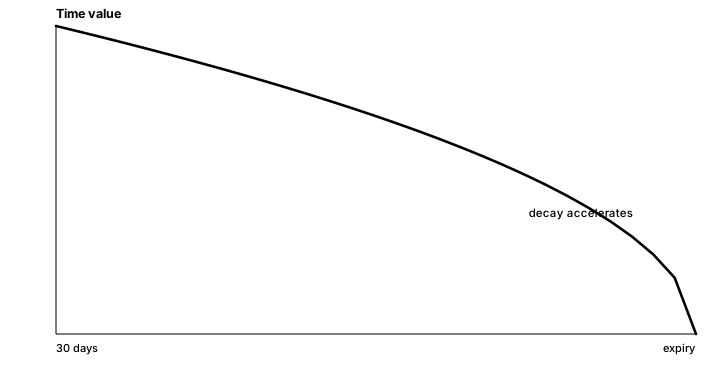
Time decay is not steady like a dripping tap. It is slow when expiry is far away and fast when it is near. An option with a month to run loses only a little each day. The same option in its final week loses value briskly, and in its last day or two the remaining time value falls off a cliff toward zero. The closer to expiry, the faster the melt.
Why it hurts buyers and helps sellers
The buyer paid for time value, which is to say for hope, and every quiet day some of that hope evaporates whether or not the stock moves. The seller, who was paid that time value up front, keeps a little more of it with each passing day. This is the mechanical reason, more than any single bad trade, that most option buyers lose, especially buyers of cheap, short-dated, out-of-the-money options. They are fighting a clock that never stops and never pauses.
For a buyer to profit, the stock must move far enough and fast enough to gain intrinsic value quicker than time value bleeds away. A slow move in the right direction can still lose, as the last chapter showed. And the cheapest options, the far out-of-the-money ones with only days left, are almost entirely time value with almost no time, which is why they so often melt straight to zero. Weekly options, with little time to begin with, decay especially fast: cheap to buy, brutal to hold.
What to carry forward
An option loses time value every day as expiry approaches, slowly at first and then sharply in the final days, and since a motionless stock leaves intrinsic value untouched, that daily loss is pure time value melting away. Decay works against the buyer and for the seller, and it is the deepest reason most buyers of cheap, short-dated options lose. To beat it, the underlying has to move far enough and fast enough to build intrinsic value quicker than time value drains, which is a higher bar than simply being right about direction.
You have now met the forces of price and time. There is a third, volatility, and together these are described by a set of measures with Greek names. The next part introduces them gently, starting with the three forces before the jargon.