Course contents
Lots and contract value
Options are quoted per share but traded in fixed lots, so one lot costs the premium times the lot size. The contract value, price times lot size, is the larger exposure behind it.
- Define the lot and the contract value
- Convert a per-share premium into the cost of one lot
- Understand why the per-share quote hides the real money at stake
You spot a Nifty option quoted at eighty rupees and think, that is cheap, I will pick up one. But you cannot buy one share's worth of an option. Options trade in fixed bundles called lots, and the real money at stake is far larger than the quoted premium suggests. This catches almost every beginner, and it is exactly where people take much bigger bets than they meant to.
Options trade in lots
A lot is a fixed bundle of units of the underlying, set by the exchange, and options are bought and sold only in whole lots. You do not trade one share of an option. You trade one lot, or two, or ten. Each underlying has its own lot size, and the exchange revises these from time to time, so the current lot size is something you check rather than memorise.
The premium is per share, the cost is per lot
Here is the catch. The premium is quoted per share of the underlying, but you pay it on every unit in the lot. So the real cost of one lot is the premium times the lot size.
If a stock option shows a premium of twenty rupees and the lot size is, say, three hundred shares, one lot costs twenty times three hundred, which is six thousand rupees. That six thousand, not twenty, is what leaves your account, and for a buyer it is the most you can lose on that one lot.
Contract value: the exposure behind the lot
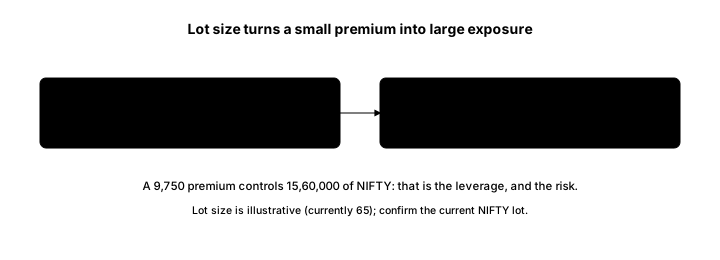
There is a second, larger number worth knowing: the contract value, which is the underlying price times the lot size. It is the notional worth of what the lot actually controls. In the example, with the stock at 1,500 and a lot of three hundred, the contract value is four lakh fifty thousand rupees. You paid six thousand in premium, but the position moves in line with a four-and-a-half-lakh exposure. That gap is the source of both the appeal and the danger of options, and it is why a seller's risk and margin are far larger than a buyer's premium.
What to carry forward
Options are quoted per share but traded in fixed lots, so the money that actually leaves your account is the premium times the lot size, and that is a buyer's maximum loss on the lot. Behind it sits the contract value, the price times the lot size, which is the real exposure the position carries and the reason a seller's risk dwarfs a buyer's premium. The single habit that keeps you safe here is to judge every trade by its per-lot cost and its contract value, not by the small per-share number on the screen.
One more distinction remains before we leave the anatomy of options. Not every option behaves the same way, and the gap between options on a single stock and options on an index matters most at expiry. That is the next chapter.