Course contents
Delta
Delta is how much an option's premium moves per one-rupee move in the underlying, running 0 to 1 for calls and 0 to minus 1 for puts. It also reads roughly as the chance of finishing in-the-money.
- Define delta with an example
- Explain the rough probability reading
- Contrast call and put delta and note that delta changes
If the stock moves by one rupee, how much does the option's premium move? That single number is delta, the first and most intuitive of the Greeks. Almost everything a beginner needs from delta follows from that one plain definition.
What delta measures
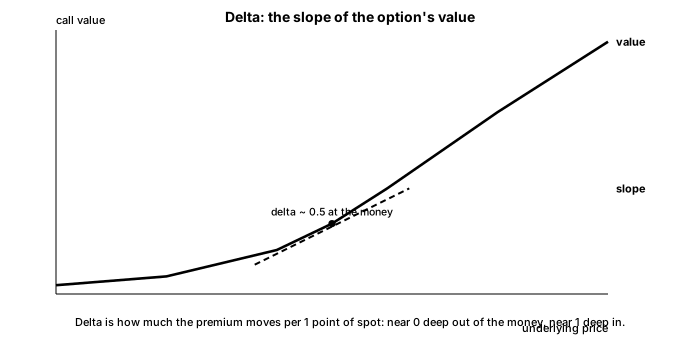
Delta is the amount an option's premium changes for a one-rupee move in the underlying. A call with a delta of 0.5 gains about fifty paise when the stock rises a rupee, and loses about fifty paise when it falls a rupee.
Delta has a natural range. A call's delta runs from 0 to 1. A put's delta runs from 0 to minus 1, negative because a put gains when the stock falls. The size of the delta tracks moneyness. A deep in-the-money option has a delta near 1 in magnitude, so it moves almost one-for-one with the stock, behaving much like the shares themselves. A far out-of-the-money option has a delta near 0, so it barely reacts to small moves. An at-the-money option sits around one half.
A rough sense of the odds
Delta carries a second, handy meaning. Its size is roughly the chance that the option finishes in-the-money at expiry. A call with a delta of about 0.30 behaves loosely as though it has around a thirty percent chance of expiring in-the-money. This is a feel, not a guarantee, and it is not exact, but it is a useful way to read how likely an option is to end up with real worth. A far out-of-the-money lottery-ticket option with a delta of 0.05 is telling you something honest about its slim odds.
One more thing: delta is not fixed. As the stock moves, delta moves too. An out-of-the-money call whose stock climbs toward the strike sees its delta rise, so the option starts reacting more strongly. That change in delta has its own name, gamma, which a later chapter covers.
What to carry forward
Delta measures how much an option's premium moves when the underlying moves a rupee, running from 0 to 1 for calls and 0 to minus 1 for puts, largest in magnitude deep in-the-money and smallest far out-of-the-money. It doubles as a rough read on the odds of finishing in-the-money, and it is not constant, since it grows as an option moves toward and into the money. Delta is the direction force from the last chapter, made into a number.
The next Greek is the one for time, which turns the time decay you already understand into a daily figure. It is called theta.