Course contents
Moneyness
Moneyness sorts options by intrinsic value into in-the-money, at-the-money, and out-of-the-money. It is a mirror image for calls and puts, and out-of-the-money options are cheap for a reason.
- Define in-the-money, at-the-money, and out-of-the-money
- Explain why moneyness is a mirror for calls and puts
- Apply the "would I exercise now" test
Run your eye down an option chain and you meet the same three characters over and over. Some options already have real worth, the kind you could bank by settling this second. Some sit balanced right at the current price. And some are pure hope, worth nothing today but cheap enough to dream on. These three states have names, and together they are called moneyness.
The three states
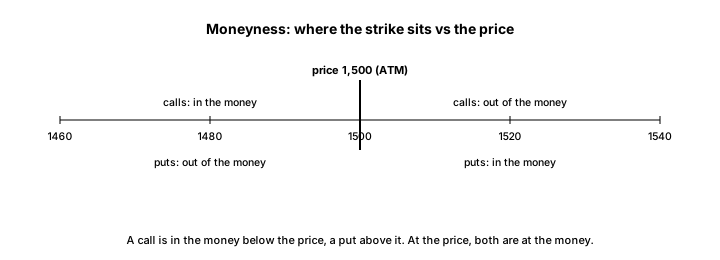
Moneyness simply asks whether an option has intrinsic value, and how much, judged by the strike against the current price.
An option is in-the-money, or ITM, when it has intrinsic value: settling it now would gain you something.
An option is out-of-the-money, or OTM, when it has no intrinsic value: settling it now would gain you nothing, so its entire premium is time value, pure hope.
An option is at-the-money, or ATM, when the strike sits right at, or very close to, the current price. It has essentially no intrinsic value and balances on the line between the other two.
A mirror for calls and puts
Whether a given strike is in or out of the money flips depending on whether you hold a call or a put, because a call profits when the price rises and a put when it falls. Take it slowly, because this is where beginners trip.
A call is in-the-money when its strike is below the current price, since the right to buy cheap is worth something. It is out-of-the-money when its strike is above the price.
A put is in-the-money when its strike is above the current price, since the right to sell dear is worth something. It is out-of-the-money when its strike is below the price.
When you get lost, one test settles it every time. Ask: if I exercised this option right now, would I gain? If yes, it is in-the-money. If no, it is out-of-the-money.
A ladder around 1,500
With Infosys at 1,500, read this ladder of strikes and watch the mirror.
| Strike | Call | Put |
|---|---|---|
| 1,440 | In-the-money | Out-of-the-money |
| 1,480 | In-the-money | Out-of-the-money |
| 1,500 | At-the-money | At-the-money |
| 1,520 | Out-of-the-money | In-the-money |
| 1,560 | Out-of-the-money | In-the-money |
Below the current price, calls are in-the-money and puts are out. Above it, the roles swap. And the strike sitting at 1,500 is at-the-money for both. The same ladder reads in opposite directions depending on which side you hold.
Why out-of-the-money options are so cheap
Beginners are drawn to out-of-the-money options for one reason: they are cheap. A far out-of-the-money Infosys call might cost only a few rupees. The appeal is obvious, since a small outlay could turn into a large percentage gain on a big move. But remember what you are buying. An out-of-the-money option has no intrinsic value at all. Its entire premium is time value, the market's price on the chance that the stock travels far enough before expiry to make the strike useful. There is nothing solid underneath it.
One last point: moneyness is not a fixed label. The strike stays put, but the price moves, so an option bought at-the-money drifts into the money as the stock moves your way, gaining real intrinsic value, or out of the money as it moves against you, sliding back into pure hope.
What to carry forward
Moneyness is the everyday language for whether an option has intrinsic value. In-the-money options carry real, settle-now worth; out-of-the-money options carry none and are entirely hope; at-the-money options balance on the boundary. It is a mirror image for calls and puts, calls in-the-money below the price and puts in-the-money above it, and the exercise-now test resolves any confusion. Cheap out-of-the-money options are cheap for a reason, and most of them expire worthless.
You have now seen intrinsic value, time value, and moneyness on single options. The next chapter shows where you see them all at once, laid out for every strike: the option chain.